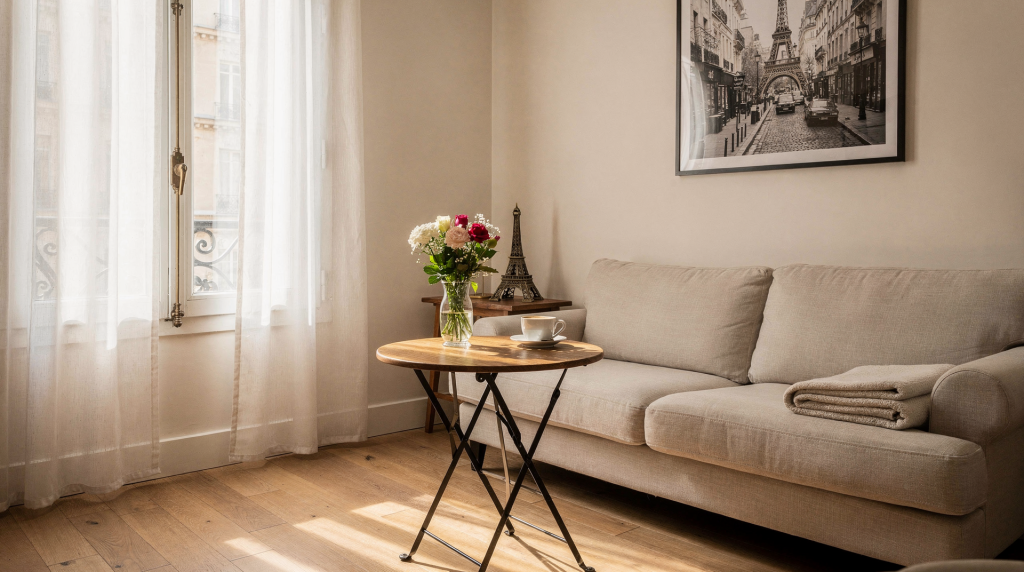
Few things reveal more about daily life in France than the way people talk about where they live. Whether you’re chatting with a neighbour over the garden wall, deciphering a rental ad, or explaining to an artisan exactly which wall needs replastering, the vocabulary of home is practical, precise, and deeply woven into local culture. Once you move beyond textbook nouns and start using the phrases French speakers actually reach for, you’ll notice how naturally conversations open up — and how much easier it becomes to navigate everything from house-hunting to small talk at the boulangerie.
Why this topic matters
If you live in France, plan to move, or simply want to sound more at ease in everyday exchanges, you need more than a handful of isolated words. You need the names of rooms, furniture, and housing types, but also the short, reusable sentence patterns that let you describe your home without mentally translating each syllable. The goal isn’t a vocabulary list you memorise and forget. It’s being able to say — without hesitation — what kind of home you have, how many rooms it contains, where it sits, what’s inside, and what state it’s in. These are the building blocks of real conversation, the kind that starts with Vous habitez dans quel type de logement ? and quickly turns into a discussion about neighbourhoods, renovation projects, or the morning light in the kitchen.
The most useful home vocabulary in French
Start with the core words you’ll use constantly — the ones that appear in every property listing, every chat about moving, and every attempt to describe your own four walls. These are your foundation.
| English | French |
|---|---|
| house | la maison |
| home | la maison / à la maison |
| apartment | l’appartement |
| room | la pièce |
| kitchen | la cuisine |
| bedroom | la chambre |
| bathroom | la salle de bain |
| living room | le salon |
| dining room | la salle à manger |
| garden | le jardin |
| balcony | le balcon |
| attic | le grenier |
| basement | le sous-sol |
Common furniture and objects:
- the sofa — le canapé
- the chair — la chaise
- the table — la table
- the bed — le lit
- the wardrobe/closet — l’armoire, le placard
- the fridge — le réfrigérateur
- the oven — le four
- the sink — le lavabo or l’évier
Notice how le lavabo typically refers to a bathroom sink, while l’évier is the kitchen sink. This kind of precision matters more than you’d think when you’re standing in a hardware store or describing a plumbing issue over the phone.
House, apartment, or flat?
In French, the distinction between types of dwellings carries weight — not just legally, but socially and practically.
- Une maison — a house, usually detached or semi-detached, often with a garden. In rural areas it might be a stone mas or a longère, but in everyday speech maison covers all of that.
- Un appartement — an apartment, from a compact studio to a sprawling Haussmannian flat.
- Un logement — a broader term for housing, a place to live. You’ll see it in official contexts: logement social, logement étudiant.
- Un studio — a one-room apartment, almost always with a kitchenette and a bathroom. It’s a specific legal category in French rental contracts.
In conversation, maison can also mean “home” in a more emotional sense, especially in phrases like à la maison. When a French person says Je rentre à la maison, they’re not necessarily walking into a standalone house — they’re going home, wherever that may be.
How to describe your home in simple French
These sentence patterns are the ones you’ll lean on again and again. They’re short, adaptable, and instantly make you sound more at ease.
- J’habite dans une maison. — I live in a house.
- J’habite dans un appartement. — I live in an apartment.
- Ma maison a trois chambres. — My house has three bedrooms.
- Il y a un jardin. — There is a garden.
- Nous avons un balcon. — We have a balcony.
- C’est une vieille maison. — It’s an old house.
A particularly natural structure, and one you’ll hear constantly, is:
Dans ma maison, il y a…
In my house, there is/are…
Examples:
- Dans ma maison, il y a une grande cuisine.
- Dans mon appartement, il y a deux chambres et un petit salon.
- Dans notre maison, il y a un grenier mais pas de garage.
This pattern works because it lets you list features without complicated grammar. It’s the conversational equivalent of opening a door and showing someone around.
Rooms in the home: the French you really need
Here are the rooms most likely to come up in conversation, whether you’re describing your own place or trying to understand a rental ad.
- la cuisine — kitchen
- le salon — living room
- la chambre — bedroom
- la salle de bain — bathroom
- les toilettes — toilet
- la salle à manger — dining room
- le bureau — study or office
- la buanderie — laundry room
- le couloir — hallway
- l’escalier — stairs
Useful nuance
French speakers almost always separate salle de bain and toilettes. In many homes, they are not the same room. A salle de bain contains a bath or shower (and often a sink), while the toilet is in its own small space — sometimes right next door, sometimes down the corridor. This isn’t just a linguistic quirk; it reflects a cultural preference for keeping bathing and toileting distinct. When you’re looking at floor plans or visiting a property, knowing this distinction saves you from awkward surprises.
Describing where your home is
Location is everything in French property talk, and the phrases below will help you answer the inevitable C’est où ? with confidence.
- Ma maison se trouve près de… — My house is located near…
- J’habite en centre-ville. — I live in the city centre.
- J’habite à la campagne. — I live in the countryside.
- C’est un quartier calme. — It’s a quiet neighbourhood.
- La maison est près de la gare. — The house is near the train station.
- L’appartement est au deuxième étage. — The apartment is on the second floor.
Important French habit
Floor numbering can trip up even seasoned travellers. In France, the ground floor is le rez-de-chaussée. The first floor above ground level is le premier étage. So deuxième étage means what an American or Brit would call the third floor. Always check carefully when renting, reading an address, or buzzing an intercom. I’ve seen more than one visitor standing outside the wrong door because they assumed the numbering matched their home country.
Adjectives that help you sound natural
To describe a home with any precision, you need a small set of high-value adjectives. These are the ones that appear in listings, conversations, and your own mental picture of a place.
| English | French |
|---|---|
| old | ancien / vieux |
| new | neuf / récent |
| small | petit |
| big | grand |
| bright | lumineux |
| quiet | calme |
| modern | moderne |
| comfortable | confortable |
| spacious | spacieux |
| narrow | étroit |
Examples:
- C’est une vieille maison avec beaucoup de charme.
- Nous avons un petit appartement lumineux.
- La cuisine est moderne et très pratique.
- Le salon est spacieux, mais la chambre est petite.
Pay attention to the difference between ancien and vieux. Ancien often implies “old” with a sense of heritage or character — an ancienne ferme is a former farmhouse, not just an old one. Vieux is more straightforward, sometimes carrying a hint of wear and tear. In property ads, ancien is the word that sells charm.
Practical phrases for daily conversation
These are the lines that move you from textbook French to the kind of talk that actually happens in kitchens, estate agents’ offices, and over the fence.
- Je vis seul(e). — I live alone.
- Nous habitons avec nos enfants. — We live with our children.
- Je suis locataire. — I’m a tenant.
- Je suis propriétaire. — I’m an owner.
- Nous louons un appartement. — We rent an apartment.
- Nous cherchons une maison. — We are looking for a house.
- La maison a besoin de travaux. — The house needs work.
- Il faut repeindre la cuisine. — The kitchen needs repainting.
Notice how travaux pops up everywhere. It’s the catch-all term for renovation, repair, or building work. When a French friend says On a des travaux dans la salle de bain, expect dust, noise, and a temporary camping shower in the garden. It’s a word that signals both ambition and a certain acceptance of disorder — very French.
Talking about a home like a local: useful housing terms
If you’re in France long-term, these words will appear in every rental contract, every property discussion, and every conversation with a landlord or syndic (building manager). They’re not glamorous, but they’re essential.
- le bail — lease
- le locataire — tenant
- le bailleur — landlord
- la copropriété — co-ownership / apartment building ownership structure
- les charges — service charges / building fees
- l’état des lieux — move-in/move-out condition report
- l’assurance habitation — home insurance
- les travaux — repairs / renovation work
- le diagnostic immobilier — property condition report
These terms matter because they define what a home really costs and what you’re responsible for. Charges, for example, can include heating, water, lift maintenance, and cleaning of common areas — and they vary wildly from one building to another. L’état des lieux is a detailed, room-by-room inspection document signed by both tenant and landlord; it’s the single most important piece of paper when you move in or out, and it can determine whether you get your deposit back. Understanding these words isn’t just about language — it’s about protecting yourself.
Common mistakes English speakers make
1. Using home too literally
In French, maison can mean “house,” but “home” is often expressed with à la maison or through context. Saying Je suis dans la maison is grammatically correct, but it emphasises being physically inside the building. The natural way to say “I’m at home” is Je suis à la maison. The difference is subtle but important: French tends to treat home as a location rather than an abstract concept.
2. Confusing salon and salle à manger
Le salon is the living room, the place where you relax, watch television, or entertain guests. La salle à manger is specifically the dining room. In many modern French homes, these spaces have merged into an open-plan salle à manger ouverte sur le salon, but the terms remain distinct.
3. Forgetting French article patterns
French home vocabulary almost always needs an article: le canapé, la cuisine, l’appartement. Dropping the article is a classic anglicism that immediately marks you as a non-native speaker.
4. Translating room names too mechanically
Some English terms don’t map one-to-one. Bureau can mean study, office, or desk depending on context. Une chambre is a bedroom, but une chambre de bonne is a tiny maid’s room, often on the top floor of a Parisian building. Context and collocation are everything.
A step-by-step way to introduce your home in French
Use this simple structure to build a clear, natural description of your home. It works whether you’re introducing yourself in a French class, writing a short bio for a rental application, or just making conversation.
Step 1: Say what type of home it is
- J’habite dans une maison.
- J’habite dans un appartement.
Step 2: Give the general size
- C’est petit.
- C’est spacieux.
- C’est une grande maison.
Step 3: Mention the number of rooms
- Il y a trois chambres.
- Il y a une cuisine ouverte.
- Il y a deux salles de bain.
Step 4: Add one or two features
- Il y a un balcon.
- Il y a un jardin.
- Il y a une cheminée.
Step 5: Add location or atmosphere
- C’est dans un quartier calme.
- C’est près du centre.
- La vue est belle.
Model answer
J’habite dans un appartement lumineux au deuxième étage. Il y a deux chambres, un salon, une cuisine ouverte et un petit balcon. C’est près du centre, mais le quartier est calme.
This kind of mini-presentation is something I often practise with newcomers. Once you can deliver it smoothly, you’ll feel far more confident when the topic turns to where and how you live.
Mini vocabulary list for real-life conversations
If you want the fastest possible progress, learn these first. They’re the words that appear in almost every exchange about housing, from casual chats to formal paperwork.
- maison
- appartement
- pièce
- cuisine
- chambre
- salon
- salle de bain
- balcon
- jardin
- locataire
- propriétaire
- charges
- travaux
- à la maison
Checklist: can you talk about your home yet?
Run through this quick self-check. If you can do each of these without reaching for a dictionary, you’re ready for real-world conversations.
- I can say whether I live in a house or apartment.
- I can name the main rooms.
- I can describe size and condition.
- I can mention location.
- I know a few rental and property terms.
- I can talk about my home without translating every word in my head.
FAQ
What is the difference between maison and appartement?
Maison means house — a standalone or semi-detached dwelling, typically with its own entrance and often a garden. Appartement means apartment, a unit within a larger building. In everyday French, maison can also be used more generally for “home” depending on context, as in Je suis à la maison (I’m at home), regardless of whether you live in a house or a flat.
How do you say “at home” in French?
You say à la maison. This is the standard expression for “at home,” whether you’re talking about being physically present or the general idea of home. Chez moi is also common and means “at my place.”
How do you say “my house has three bedrooms”?
Ma maison a trois chambres. You can also say Il y a trois chambres dans ma maison. Both are perfectly natural.
What is the French word for living room?
The most common word is le salon. In some contexts, especially in older or more formal homes, you might hear le séjour or la salle de séjour, but salon is the everyday term.
What is the difference between salle de bain and toilettes?
Salle de bain is the bathroom, the room with a bath or shower (and often a sink). Toilettes are the toilet or restroom. In many French homes, these are separate rooms. When you’re a guest, it’s polite to ask for les toilettes, not la salle de bain, unless you actually need to wash up.
How do you describe an old house in French?
You can say c’est une vieille maison or c’est une maison ancienne. The second sounds a little more formal and often suggests charm, character, or historical value rather than mere age. In property listings, ancien is the preferred term because it carries positive connotations.
Final takeaway
If you want to talk about your home in French, focus on the words people actually use every day: the type of home, the rooms, the location, and a few practical housing terms. Once you can say J’habite dans une maison, Il y a un jardin, and C’est un quartier calme, you already have a solid base for real conversation — chez vous and beyond. The beauty of this topic is that it’s immediately useful. Every time you describe your place to a neighbour, read a petite annonce, or chat with a plumber about les travaux, you’re reinforcing the language and deepening your connection to the way French life is actually lived, one room at a time.