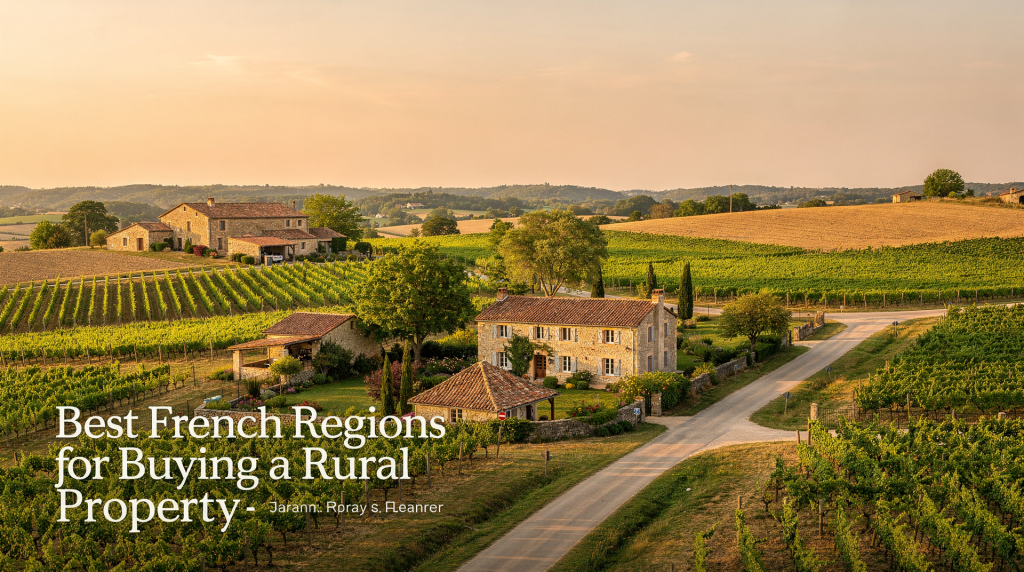
When someone tells me they want to buy a rural house in France, my first question is never “what’s your budget?” It’s “what do you want your Tuesday mornings to look like in January?” Because a stone farmhouse in the Lot can be idyllic in August and a logistical puzzle in February, and the real cost of a property isn’t the price on the compromis de vente — it’s the life that comes with it.
Over the past few years, the market has quietly reshuffled. Inland departments in the centre, north-east, and parts of the south-west still offer some of the most compelling value, while the Mediterranean fringe and Alpine valleys have pulled decisively away into premium territory. But the numbers only tell you so much. What matters is how a region fits the texture of your daily life: the distance to a boulangerie that stays open year-round, the way an old house breathes in winter, the difference between a hameau with three occupied houses and one with twelve.
What “best” really means when buying in rural France
“Rural property” in France is a wonderfully elastic term. It can mean a longère — that long, low farmhouse typical of Brittany and parts of Normandy, originally built to house both family and livestock under one roofline. It can mean a fermette, a small former farm with outbuildings, or a maison de village tucked into a bourg of three hundred people. In the south, you’ll see mas (Provençal farmhouses) and bastides (fortified stone houses, especially in the Lot and Aveyron). Each term carries a set of assumptions about construction, maintenance, and the kind of life the building was designed for.
In practice, the “best” region depends on four things that interact more than buyers expect:
- Your budget — not just for purchase, but for the inevitable travaux
- Your tolerance for renovation — and your honest assessment of how much French you speak when dealing with artisans
- How important access is to shops, trains, and airports — remembering that a 40-minute drive to a gare SNCF can feel very different in fog or ice
- Whether you want a holiday base or a long-term home — because the criteria for a résidence secondaire and a résidence principale diverge sharply
If you want a property that works year-round, choose a region with reliable access, decent services nearby, and a climate you can live with in winter as well as summer. If you want character and lower prices, the trade-off is often more maintenance, older heating systems, and more limited local infrastructure. I’ve seen too many people fall for a coup de cœur — the heart-stopping moment when you see exposed beams and a walnut tree — only to discover that the roof needs €30,000 of work and the nearest pharmacie de garde is 25 kilometres away.
The strongest regions to consider
Dordogne / wider Nouvelle-Aquitaine
The Dordogne remains one of the most recognisable rural property markets for overseas buyers, and it is still a favourite for a reason: attractive stone houses built in that warm local limestone, established international demand, and a lifestyle that feels distinctly French but relatively accessible. The pierre dorée of the Périgord gives the architecture a honeyed glow that photographs beautifully, but it also tells you something about the local geology — and the fact that many of these houses were built without damp-proof courses.
Why it works:
- Good balance of scenery, heritage, and livability
- Plenty of rural houses, farmhouses, and village homes — from pigeonniers to substantial maisons de maître
- Established expat network in some areas, which can ease the transition
- Many buyers find the market easier to navigate than more remote departments
What to watch:
- Popularity can push prices up in the most desirable pockets — the golden triangle around Sarlat is no secret
- Some homes are beautiful but energy-inefficient; check the diagnostic de performance énergétique (DPE) carefully
- Good properties are often snapped up quickly, sometimes before they reach public listings
Best for:
- Buyers wanting a classic rural France experience
- People who value culture, food, and gentle tourism infrastructure
- Those who want a mix of charm and resale appeal
Charente and Charente-Maritime
Charente is often recommended for buyers seeking a softer climate, pretty villages, and relatively good value compared with the most famous regions. The architecture here tends toward pale stone and Romanesque influences, with a quiet elegance that doesn’t shout for attention. Charente-Maritime adds proximity to the Atlantic and more summer demand, which can be useful if you want easier rental potential or a livelier coastal-adjacent lifestyle.
Why it works:
- Attractive prices in many inland areas — you can still find a solid village house with a courtyard for a reasonable sum
- Easy-going pace of life; the art de vivre here is understated but genuine
- Good access to southwestern France transport routes, including the TGV at Angoulême
- Strong appeal for buyers who want rural without feeling isolated
What to watch:
- Coastal zones cost more than inland parts — the île de Ré effect ripples outward
- Some villages are quiet outside summer; check whether the local épicerie closes for the winter
- Property choice varies sharply by sub-area; the difference between a village near Cognac and one in the deeper countryside is significant
Best for:
- Second-home buyers
- Retirees wanting a gentler pace
- Buyers who want charm without moving into a deeply remote area
Brittany
Brittany is one of the most practical choices for buyers who want character properties, a cooler climate, and a strong sense of local identity. The traditional Breton house is often built of granite, with a slate roof and thick walls that hold the coolness well in summer but demand attention to humidity management. Central Brittany, in particular — the Argoat, or “land of the woods,” as distinct from the coastal Armor — can offer better value than the coastal market, while still giving you access to a region with strong cultural coherence and a distinctive built environment.
Why it works:
- Temperate climate; summers rarely scorch, winters rarely freeze hard
- Good choice of traditional houses, from longères to stone cottages
- Strong regional identity and village culture — the fest-noz and local markets are not just for tourists
- Often a sensible compromise between price and livability
What to watch:
- Rain and humidity matter when evaluating old stone homes; look for signs of salpêtre (saltpetre) on walls
- Some inland villages have fewer services; a car is non-negotiable
- Coastal and popular tourist areas are more expensive — the presqu’île de Crozon or the Golfe du Morbihan command premiums
Best for:
- Buyers who want a cooler, greener region
- People who care about local culture and community
- Those looking for a proper year-round home, not just a holiday base
Normandy
Normandy appeals to buyers who want accessible rural France with a cooler climate, historic villages, and relatively straightforward access from northern Europe. The architectural signature here is unmistakable: colombages — half-timbered houses — and chaumières (thatched cottages) in the Pays d’Auge, stone farmhouses in the Cotentin. It is especially attractive if you prefer lush landscapes and a region that remains practical for frequent trips back and forth.
Why it works:
- Easy access from the UK and northern France routes; ferry ports and the tunnel are within reach
- Character houses with strong regional identity — a Norman ferme is instantly recognisable
- Good choice for buyers who do not want extreme summer heat
- Some inland areas remain reasonably priced, particularly in the Orne and southern Manche
What to watch:
- Damp management is crucial in older homes; colombages need regular maintenance of the timber and infill
- Winters can feel grey and wet — the crachin (fine drizzle) is a real phenomenon
- Not every “country home” is genuinely low-maintenance; thatched roofs require specialist care
Best for:
- Buyers prioritising access and convenience
- People who prefer a cooler climate
- Anyone drawn to half-timbered or orchard-country settings — the pays d’Auge in autumn is spectacular
Limousin / Creuse / Haute-Vienne / Corrèze
If affordability is the main objective, this is one of the first zones to study closely. Recent price data shows departments such as Creuse, Haute-Marne, Nièvre, Meuse, and Indre among the lowest-priced rural markets, while Corrèze and Haute-Vienne are also frequently cited as strong-value areas. The Limousin is often called la France profonde — deep France — and that phrase captures both its appeal and its challenge. You can buy a substantial stone house with outbuildings and land for the price of a studio apartment in Lyon, but you’ll need to be comfortable with silence and self-reliance.
Why it works:
- Some of the lowest purchase prices in France; the prix au mètre carré can be startlingly low
- Large houses and land can still be found — corps de ferme with multiple barns are not unusual
- Often ideal for buyers who need space more than prestige
- Negotiation room is common in less competitive markets; sellers expect it
What to watch:
- Fewer services in some locations; the désert médical (medical desert) is a real concern in parts of the Creuse
- Longer distances to hospitals, stations, and airports — Limoges airport is useful but not comprehensive
- Resale may be slower than in better-known regions; patience is essential
Best for:
- Budget-conscious buyers
- Renovation buyers — but only if you have a reliable local artisan or serious DIY skills
- People wanting space, silence, and land
Occitanie interior and the south-west inland belt
Departments such as Lot, Aveyron, and Gers are highly sought after for rolling landscapes, stone farmhouses, and a strong rural identity. The causses — the limestone plateaus — and the river valleys create a landscape that feels ancient and deeply French. These areas often combine authentic village life with enough access to make long-term living realistic, though the summer heat is not to be underestimated.
Why it works:
- Beautiful landscapes and classic rural architecture — pierre sèche (dry stone) walls, lauze roofs, and bastides
- Strong food culture; the Gers is the heartland of foie gras and armagnac, the Aveyron of aligot and roquefort
- Good mix of inhabited villages and rural seclusion
- Often more character per euro than famous coastal zones
What to watch:
- Summer heat can be significant in some areas; a house without thick walls or shutters can become uncomfortable
- Distance between villages can be greater; the département of the Lot is sparsely populated
- Old houses may need cooling and insulation upgrades — the canicule (heatwave) is no longer a rare event
Best for:
- Buyers who want a more southern feel without the Mediterranean price tag
- Food and wine lovers
- Those who want a traditional French countryside setting with genuine agricultural rhythms
Quick comparison table
| Region | Typical appeal | Main advantage | Main caution |
|---|---|---|---|
| Dordogne / Nouvelle-Aquitaine | Classic rural France | Strong lifestyle appeal and broad buyer recognition | Popular pockets can be pricey |
| Charente | Balanced value | Good compromise between access and affordability | Some areas are very quiet outside summer |
| Brittany | Climate and identity | Temperate weather and strong local culture | Damp and upkeep in older granite homes |
| Normandy | Access and character | Convenient for travel and historic half-timbered houses | Damp, wind, and winter greyness |
| Limousin / Creuse / Haute-Vienne | Lowest budgets | Some of the cheapest rural prices in France | Fewer services and slower resale |
| Lot / Aveyron / Gers | South-west charm | Stone houses and strong food and wine culture | Heat and remoteness in some areas |
How to choose the right region for your rural property
1. Start with your lifestyle, not the listing
I’ve learned to ask myself — and anyone I advise — a set of questions that cut through the romance of exposed stone and lavender borders:
- Will I live here year-round or only in summer? A house that’s charming for two weeks in July can feel very different in November’s pluie battante.
- Do I need supermarkets, doctors, and stations nearby? The French term zone rurale isolée has a precise administrative meaning — it’s worth knowing if your target village falls into it.
- Do I want cultural life or total quiet? Some communes have an active comité des fêtes; others roll up the pavements at 7 p.m.
- Can I handle a property that needs regular maintenance? An old house is a relationship, not a transaction.
A beautiful house in the wrong place is still the wrong purchase. I’ve seen it happen: a stunning fermette in the Morvan that turned out to be a 45-minute drive from the nearest boulangerie open in winter. The owners lasted eighteen months.
2. Read the map like a local
In rural France, two villages only 20 kilometres apart can feel completely different. One may sit near a market town and train line; the other may be lovely but functionally isolated. The French have a useful distinction between a bourg (a small town with services), a village, and a hameau (a hamlet, often just a handful of houses). Know which one you’re buying into.
Check:
- Travel time to the nearest town — and whether that town has a marché hebdomadaire that runs year-round
- Winter access roads — some routes départementales are not prioritised for snow clearance
- Mobile signal and internet — the zone blanche (dead zone) is still a reality in parts of the Massif Central and deep countryside
- Distance to schools, pharmacie, and medical care — the désert médical is a growing political issue
- Flood risk, forest fire exposure, or wind exposure where relevant — the plan de prévention des risques (PPR) is a public document worth consulting
3. Compare more than asking price
Lower prices can hide real costs. A €60,000 stone house in the Creuse may need €80,000 of work before it’s comfortably habitable. The French notary system provides a diagnostic technique — a pack of surveys covering everything from lead and asbestos to energy performance and natural risks — but it’s a snapshot, not a guarantee.
Common hidden costs include:
- Roof work — toiture à refaire is a phrase that should make you pause
- Septic system replacement — assainissement non conforme can mean a mandatory upgrade within a year of purchase
- Insulation — many old houses have none; the DPE will tell you how bad it is
- Heating upgrades — replacing an old chaudière fioul (oil boiler) with a heat pump is a significant project
- Moisture treatment — traitement de l’humidité is a specialist job, not a DIY weekend
- New electrics — if the tableau électrique looks like it dates from the 1960s, budget for a full rewire
A cheaper house in a low-price region is not always the cheaper purchase overall. The coût global — total cost over five to ten years — is the number that matters.
Common mistakes buyers make
- Choosing a region because it is famous, not because it fits daily life — the Dordogne is wonderful, but it’s not the only place with stone houses and good markets
- Underestimating damp, especially in old stone or timber homes — salpêtre, mould, and musty smells are warning signs, not character features
- Ignoring access in winter — a picturesque lane can become a mudslide or an ice rink
- Assuming “rural” means quiet but still convenient — some villages lose their only épicerie and café within a year of your arrival
- Forgetting resale value if plans change — a property that took two years to sell when you bought it will likely take two years to sell when you leave
- Not checking how local villages function outside tourist season — visit in November, not August, before you commit
A practical buying checklist
Before you commit to a region, check:
- How long it takes to reach a hospital and major supermarket — time it, don’t guess
- Whether the area stays active all year — ask at the mairie about local associations and winter events
- Local house price levels in nearby departments — the notaires de France publish useful data online
- Internet and mobile coverage — use the Arcep (French telecoms regulator) coverage maps, not the agent’s assurances
- Transport links to airports or TGV stations — and whether those links run in winter
- Climate extremes: heat, frost, humidity, wind — the Météo France archives are your friend
- Local property stock: stone farmhouse, cottage, longère, hamlet house, land — understand what’s typical for the area
Which regions suit which buyers?
- Best all-rounder: Dordogne / wider Nouvelle-Aquitaine — a safe bet for lifestyle, resale, and accessibility
- Best for value: Creuse, Haute-Vienne, Corrèze, Indre, Nièvre — where your euro stretches furthest
- Best for temperate weather: Brittany and Normandy — cooler summers, milder winters, but damp is a constant companion
- Best for a southern rural feel: Lot, Aveyron, Gers — stone, sunshine, and a strong sense of terroir
- Best for access and convenience: Normandy and parts of Charente — practical for frequent travellers and those who want to stay connected
FAQ
Is rural property still affordable in France?
Yes, especially in central, north-eastern, and some inland south-western departments where average prices remain well below the national premium zones. The key is to look beyond the famous regions and understand that affordability often comes with trade-offs in services and accessibility.
Which French regions are most popular with foreign buyers?
Dordogne, Charente, Brittany, Normandy, and parts of Nouvelle-Aquitaine remain especially well known with international buyers. Each has its own established networks and a track record of cross-border transactions, which can make the legal and practical process smoother.
Where are the cheapest rural houses in France?
Recent data shows departments such as Creuse, Haute-Marne, Nièvre, Meuse, and Indre among the lowest-priced areas. These are often in what the French call la diagonale du vide — the low-density diagonal stretching from the Ardennes to the Massif Central — where depopulation has kept prices low for decades.
Which region is best for a year-round home?
That depends on access and services, but Normandy, Brittany, Charente, and parts of Dordogne are often practical choices for full-time living. Look for a bourg with a school, a pharmacie, and a weekly market — these are good indicators of a community that functions all year.
Should I buy in a famous region or a cheaper inland one?
Buy where the house, climate, and practical day-to-day life match your needs. A less famous region often gives better value and more space, while a famous region may offer stronger resale and easier lifestyle support. Neither is inherently better — it’s about the fit with your life.
Conclusion
The best French region for buying a rural property is the one that fits your life as well as your budget. Dordogne and the wider Nouvelle-Aquitaine remain strong all-round choices, Brittany and Normandy are excellent for temperate weather and access, and inland departments such as Creuse, Haute-Vienne, Corrèze, and Indre offer some of the best value in the country.
If you want the smartest purchase, compare regions on more than charm: check access, climate, renovation risk, and daily practicality before you fall for the view. The right house in the right region isn’t just a beautiful place — it’s a place where your life can actually unfold, season after season.