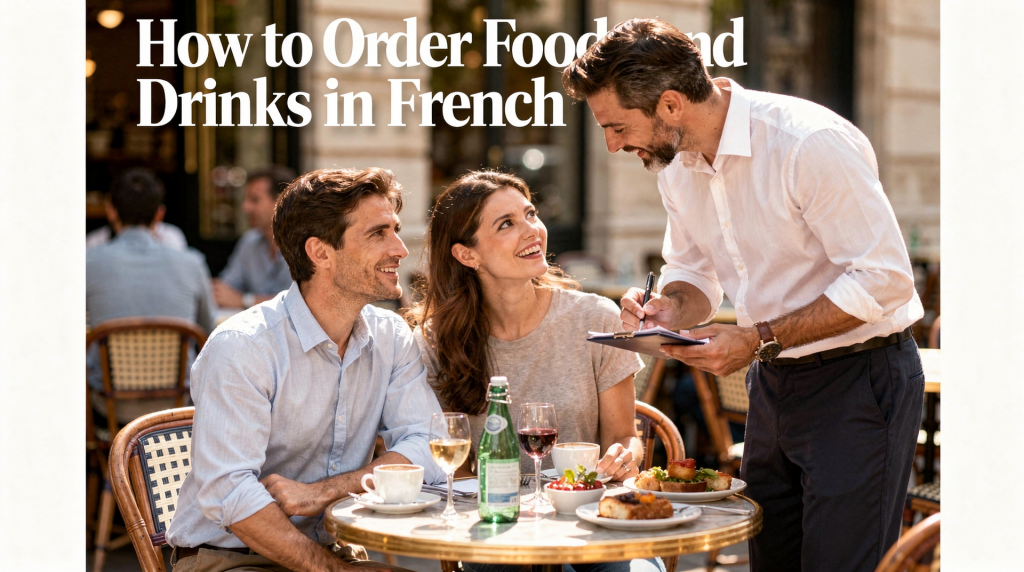
When I first walked into a stone‑walled village café in the Drôme, I tried to translate every word in my head. It was exhausting — and it didn’t work. Then I noticed something: the same handful of phrases floated from table to table, whether I was in a Provençal bistro, a Breton crêperie, or a no‑nonsense Parisian brasserie. Ordering in French isn’t about building sentences from scratch. It’s about learning a few solid patterns that fit almost any situation. Once you have them, you can ask for what you want with the kind of ease that makes locals nod in approval — and that’s a quiet victory worth more than perfect grammar.
Why this matters
French service culture is a delicate balance of warmth and efficiency. The server isn’t your best friend, but they’re not a machine either. What they expect — and genuinely appreciate — is that you respect the basic social choreography: greet first, order clearly, and wrap your request in the soft padding of s’il vous plaît and merci. Skip the greeting, and you risk being labelled as abrupt, even if your French is flawless. The good news is that you don’t need elaborate grammar to get it right. A small set of expressions, delivered with a calm smile, will carry you further than you’d imagine. This isn’t just about language; it’s about stepping into a daily ritual that the French hold dear — and being welcomed because you made the effort.
The most useful French phrases for ordering
Think of these phrases as the load‑bearing walls of a French meal. They’re simple, they’re sturdy, and you can build almost any order on top of them. Once they become second nature, you’ll stop worrying about structure and start enjoying the food.
| French | English | When to use it |
|---|---|---|
| Bonjour / Bonsoir | Hello / Good evening | Always start here |
| Nous sommes prêts à commander | We’re ready to order | When the server arrives |
| Pourrions-nous commander, s’il vous plaît ? | Could we order, please? | If you want to start ordering |
| Je voudrais… | I would like… | Polite and safe in any setting |
| Je vais prendre… | I’ll have… | Very common and natural |
| Pour moi, ce sera… | For me, I’ll have… | Natural in restaurants |
| Qu’est-ce que vous recommandez ? | What do you recommend? | When you want advice |
| Quelle est la spécialité de la maison ? | What is the house specialty? | Good in bistros and restaurants |
| L’addition, s’il vous plaît | The bill, please | When you are finished |
A useful pattern is:
- Je voudrais + item + s’il vous plaît
- Je vais prendre + item
- Pour moi, ce sera + item
Examples:
- Je voudrais un café, s’il vous plaît.
- Je vais prendre une bière.
- Pour moi, ce sera le poulet rôti.
Je voudrais is the safest choice — it’s the conditional, so it softens the request into a polite wish. Je vais prendre sounds a touch more decisive, as if you’ve already made up your mind, and Pour moi, ce sera has a gentle, almost conversational rhythm that fits right in at a relaxed dinner. All three are perfectly acceptable; pick the one that feels most comfortable on your tongue.
How to order in a café or brasserie
Cafés and brasseries are the ideal training ground. The menu is usually short, the pace is quick, and the staff have heard every possible variation of an order. In a village café — the kind where the same retirees play cards by the window every morning — a well‑placed Bonjour and a clear request will often earn you a warmer smile than in a busy city spot, but the mechanics are identical.
Common drink orders
| French | English |
|---|---|
| un café | a coffee |
| un café noisette | coffee with a little milk |
| un thé | a tea |
| un chocolat chaud | a hot chocolate |
| un verre d’eau | a glass of water |
| une carafe d’eau | a carafe of tap water |
| un jus d’orange | orange juice |
| un soda | a soft drink |
| une bière pression | draught beer |
| un verre de vin rouge / blanc / rosé | a glass of red / white / rosé wine |
One detail worth knowing: un café almost always means a small, intense espresso. If your palate leans towards a longer, milder coffee, you’ll need to ask for un café allongé or un grand café. A café noisette gets its name from the hazelnut colour the milk gives the coffee — it’s a modest dash, not a latte.
Useful café phrases
- Un café, s’il vous plaît.
- Une carafe d’eau, s’il vous plaît.
- Un verre de vin blanc, s’il vous plaît.
- L’addition, s’il vous plaît.
These are your daily drivers. Short, polite, and impossible to get wrong.
Important nuance
In France, une carafe d’eau means tap water, and it’s a completely normal, expected request. By law, any establishment serving food must provide free drinking water, so don’t hesitate. In regions where the tap water is very hard — parts of the south, for example — you might occasionally be offered filtered water, but a simple carafe is the default. If you want sparkling water, ask for une eau gazeuse or une eau pétillante (both are used interchangeably). For still bottled water, say une eau plate. This distinction matters because if you just say “water,” you’ll get the carafe, which is exactly what most locals drink.
How to order in a restaurant
Restaurant ordering follows a slightly more formal rhythm. The server may approach first for the apéritif, then return for the food order. The meal itself is structured — starter, main, dessert — and many places offer a menu (a set formula) that’s better value than ordering à la carte. Knowing the difference between the two words is half the battle.
Understand the menu first
| French | English |
|---|---|
| la carte | the menu |
| le menu | set menu |
| le plat du jour | dish of the day |
| le menu du jour | menu of the day |
| les entrées | starters |
| les plats | main dishes |
| les desserts | desserts |
| les boissons | drinks |
| la spécialité de la maison | house specialty |
La carte is the full list of dishes, each priced individually. Le menu is a fixed‑price combination — often a starter and main, or main and dessert, sometimes with a glass of wine. If you’re unsure which to choose, glancing at the menu du jour is always a safe bet: it’s usually fresh, seasonal, and what the kitchen wants to cook that day.
Phrases to use
- Puis-je voir la carte ? — May I see the menu?
- Avez-vous un menu du jour ? — Do you have a menu of the day?
- Qu’est-ce que vous recommandez ? — What do you recommend?
- Je vais prendre la soupe à l’oignon. — I’ll have the onion soup.
- Comme plat principal, je voudrais le poisson. — As a main course, I would like the fish.
Puis-je voir la carte ? is slightly more formal than a simple La carte, s’il vous plaît, but both are perfectly fine. Asking for a recommendation — especially about the spécialité de la maison — often opens a small door into the region’s culinary identity. In Alsace, that might be choucroute; in the southwest, cassoulet. The server’s answer tells you not just what to eat, but where you are.
A simple restaurant order
A natural, easy order sounds like this:
Bonjour. Je voudrais la soupe à l’oignon, puis le poulet rôti, et une carafe d’eau, s’il vous plaît.
That’s enough to sound clear, polite, and confident. It respects the sequence — greeting, starter, main, drink — and doesn’t try to do too much. The server will appreciate the clarity.
Ordering drinks correctly
Drinks are where many learners freeze, but the patterns are mercifully simple. Whether you’re at a zinc counter or a linen‑draped table, the same constructions work. In wine regions, don’t underestimate the power of asking for a local recommendation — it signals curiosity and often leads to a glass of something you wouldn’t have found on your own.
At the bar or table
- Un espresso, s’il vous plaît.
- Un demi, s’il vous plaît. — a small beer (usually 25 cl)
- Un verre de rouge, s’il vous plaît. — a glass of red wine
- Une bouteille d’eau plate, s’il vous plaît.
- Une carafe d’eau, s’il vous plaît.
Un demi literally means “a half,” and it’s the standard way to order a modest draft beer. In some northern towns you might hear une chope, but un demi works everywhere.
If you need to clarify
- Avec glace ou sans glace ? — With ice or without ice?
- Pétillante ou plate ? — Sparkling or still?
- C’est du vin local ? — Is it local wine?
- Quel vin vous conseillez ? — Which wine do you recommend?
In a small restaurant in the Loire Valley or the Rhône corridor, Quel vin vous conseillez ? can be the most rewarding question of the meal. The owner might bring out a bottle from a nearby vineyard that never appears on a printed list, and you’ll taste the landscape in your glass.
How to ask questions without sounding abrupt
English can tolerate a direct “The menu, please.” In French, that same brevity can land like a command. The language prefers a little cushioning — an extra word or two that acknowledges the person you’re speaking to. This isn’t about grovelling; it’s about recognising that every interaction is a tiny social exchange, not just a transaction.
Better than just saying the item
Instead of:
- La carte.
Try:
- Puis-je avoir la carte, s’il vous plaît ?
Instead of:
- Eau.
Try:
- Une carafe d’eau, s’il vous plaît.
Instead of:
- Vin.
Try:
- Un verre de vin rouge, s’il vous plaît.
The difference is a few syllables, but the effect is a warmer, more human response. You’re not just asking for something; you’re asking someone.
Polite openers you can reuse
- Excusez-moi…
- S’il vous plaît…
- Pardon…
- Est-ce que je peux… — Can I…?
- Pouvez-vous… — Can you…?
These are small words, but they change the tone completely. Excusez-moi is the verbal equivalent of a gentle knock on a door before entering.
How to order for a group
When you’re speaking for the table, the same patterns expand naturally. You might need to summarise several choices, but you don’t need to recite everyone’s order in perfect detail — the server will often go around the table anyway. Still, a collective opener helps set the stage.
- Nous allons prendre… — We’ll take…
- Pour nous, ce sera… — For us, it will be…
- Deux cafés et un thé, s’il vous plaît.
- Une salade et deux plats du jour, s’il vous plaît.
If the server asks:
- Et pour vous ? — And for you?
You can answer with your own choice directly:
- Pour moi, ce sera le poisson.
This back‑and‑forth is perfectly normal. No need to orchestrate a single, flawless group sentence.
Common mistakes to avoid
Over the years, I’ve watched learners stumble into the same handful of traps — and they’re almost never about grammar. They’re about rhythm and cultural expectation.
1. Forgetting the greeting
Starting with the order itself can sound abrupt, even rude. Always begin with Bonjour or Bonsoir. It’s the verbal handshake that opens every conversation in France, from the bakery to the bank.
2. Using only one-word requests
Coffee or Water may be understood, but it’s not the natural way to ask in French. Use Un café, s’il vous plaît or Une carafe d’eau, s’il vous plaît. The extra words signal that you see the server as a person, not a dispenser.
3. Mixing up menu words
La carte = the menu. Le menu = set menu. This confusion is very common because English uses “menu” for both. If you want the printed list of dishes, ask for la carte. If you want the fixed‑price deal, ask for le menu.
4. Overcomplicating the sentence
You do not need advanced grammar. Simple phrases are often the most natural: Je vais prendre…, Je voudrais…, Pour moi, ce sera…. Trying to construct elaborate sentences on the fly usually leads to hesitation, and hesitation can be mistaken for uncertainty.
5. Expecting tap water to be refused
In France, asking for une carafe d’eau is normal and expected. It’s not a sign of being cheap; it’s what most locals do. If you want bottled water specifically, say so clearly. But don’t be surprised if the carafe arrives without a second thought.
Step-by-step: how to order confidently
Use this simple sequence anywhere in France, from a Michelin‑starred table to a roadside routier:
- Greet the server.
- Ask for the menu if needed.
- Decide whether you want a set menu or à la carte.
- Order in short, clear phrases.
- Ask for drinks separately if needed.
- End politely.
- Ask for the bill when finished.
Example sequence
- Bonjour.
- Puis-je avoir la carte, s’il vous plaît ?
- Je vais prendre le menu du jour.
- Et une carafe d’eau, s’il vous plaît.
- L’addition, s’il vous plaît.
This script works because it mirrors the natural rhythm of a French meal. It’s not rushed, it’s not over‑familiar, and it leaves room for the server to do their job.
Mini phrase bank for real life
Keep these phrases ready. They’re the linguistic equivalent of a well‑packed toolbox — nothing fancy, but everything you need for the job.
Food
- Je voudrais…
- Je vais prendre…
- Pour moi, ce sera…
- Qu’est-ce que vous recommandez ?
- Quelle est la spécialité de la maison ?
- C’est végétarien ?
- Est-ce qu’il y a du gluten ?
Drinks
- Un café, s’il vous plaît.
- Un thé, s’il vous plaît.
- Une carafe d’eau, s’il vous plaît.
- Un verre de vin rouge, s’il vous plaît.
- Une eau plate / gazeuse, s’il vous plaît.
Service
- La carte, s’il vous plaît.
- L’addition, s’il vous plaît.
- Merci.
- Excusez-moi.
Checklist before you order
- Greet first.
- Use s’il vous plaît.
- Choose one of the safe frames: Je voudrais, Je vais prendre, or Pour moi, ce sera.
- Know whether you want la carte or le menu.
- Ask for une carafe d’eau if you want tap water.
- End with merci.
Run through this mental checklist before the server arrives, and you’ll feel grounded instead of flustered.
FAQ
Is Je voudrais polite enough?
Yes. It’s one of the safest and most polite ways to order in French. The conditional mood softens the request into a wish, which aligns perfectly with French cultural preferences for indirectness.
Can I say Je veux?
Technically yes, but it sounds much more direct and less polite — closer to “I want” than “I would like.” Use Je voudrais instead; it’s the difference between a demand and a courteous request.
What should I say if I am ready to order?
You can say Nous sommes prêts à commander or the more casual On peut commander, s’il vous plaît ? Both are clear and natural.
How do I ask for the bill?
Say L’addition, s’il vous plaît. In some informal settings you might hear la note, but l’addition is universally understood.
What is the difference between la carte and le menu?
La carte is the full menu with individually priced dishes. Le menu is a set menu or fixed‑price option, often offering a combination of courses at a better value. This distinction is one of the most common sources of confusion for English speakers, so it’s worth memorising early.
Conclusion
Ordering food and drinks in French is less about perfect grammar and more about using a few reliable, polite patterns. If you remember Bonjour, Je voudrais, Je vais prendre, une carafe d’eau, and L’addition, s’il vous plaît, you can handle most everyday situations with ease. The more you hear French in cafés and restaurants, the more natural these phrases will feel — and that is where the real progress happens. Each successful order is a small key turning in the lock of daily French life, and before long, you’ll find yourself not just speaking the language, but living it.