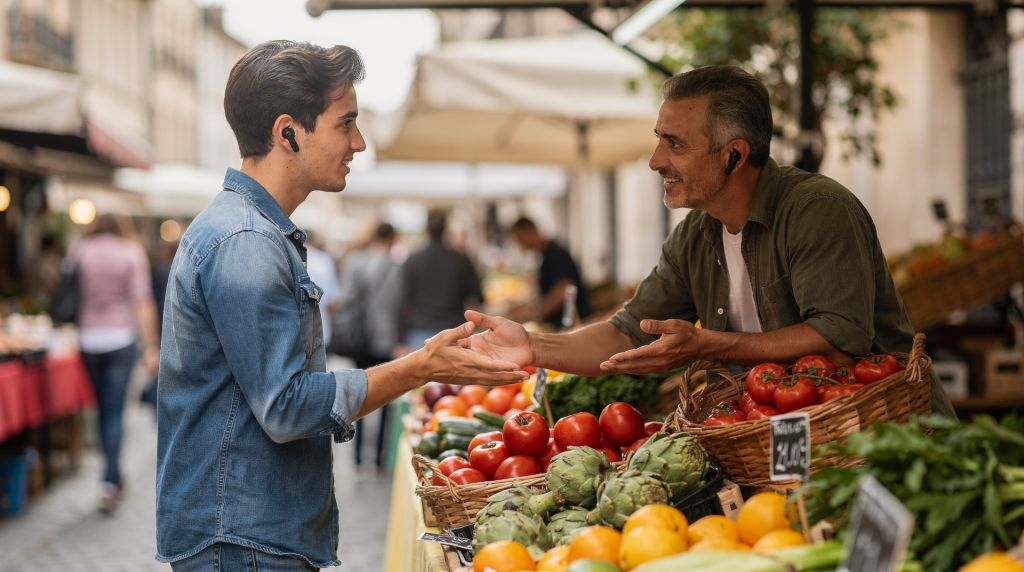
If you want to hear French as it’s actually spoken — fast, fragmentary, and full of purpose — skip the language apps for an hour and walk through a local market. The marché is not just a place to buy vegetables. It’s a weekly ritual where greetings, quantities, and quick decisions weave together into a living listening lab. I’ve stood in enough queues in the Drôme, clutching a coin purse while a vendor rattles off prices for courgettes and fromage de chèvre, to know that this is where the ear learns to catch what matters. The market gives you short, repeated exchanges anchored in visible goods — a rare combination for anyone trying to move beyond textbook French.
Why the market is such good listening practice
Classroom dialogues pretend people speak in complete sentences. At a market, nobody does. A vendor might say « Et avec ça ? » while handing you change, or call out « Deux euros la barquette, elles sont belles aujourd’hui ! » in one breath. That fragmentation is precisely what trains your ear for real life: you learn to isolate the words that carry the transaction — product, quantity, price — and let the rest flow past.
The market also runs on repetition. Every Saturday, the same phrases echo between stalls. Bonjour opens every exchange. Je voudrais… follows. C’est combien ? comes next. After a few visits, these patterns lodge themselves in your auditory memory, and you start anticipating what you’ll hear. That predictability is a gift for a learner: it reduces cognitive load and lets you focus on the details — the regional accent, the speed, the little comments about freshness that reveal so much about French food culture.
You’ll encounter greetings and politeness formulas that are non-negotiable in French social code, questions about price and quantity that force you to process numbers quickly, food vocabulary tied to what’s in season right now, short vendor replies that often drop the subject pronoun, and a rhythm of repetition that makes grammatical structures sink in without study. The market keeps French practical. Nobody asks you to conjugate the subjunctive. They ask what you want, how much, and whether you’d like to taste it.
Core phrases to recognize
These lines form the backbone of almost every market conversation. Learn to recognize them instantly, and you’ll already have a solid foothold, even when the speech around them blurs.
| French phrase | Meaning | When you hear it |
|---|---|---|
| Bonjour, Monsieur / Madame | Hello, sir / madam | At the very start of any exchange — never skip this, or the interaction turns cold |
| Je voudrais… | I would like… | When ordering or requesting; softer and more polite than je veux |
| Combien ça coûte ? | How much does it cost? | Asking the price directly |
| C’est combien ? | How much is it? | A shorter, very frequent price question |
| C’est combien le kilo ? | How much per kilo? | When buying produce sold by weight |
| Je peux goûter ? | Can I taste? | Asking for a sample — common at fruit and cheese stalls |
| C’est frais ? | Is it fresh? | Checking quality, though vendors usually volunteer this |
| C’est bio ? | Is it organic? | Asking about farming method; look for the AB label too |
| Je prends ça | I’ll take that | The moment you commit to buying |
| Merci beaucoup | Thank you very much | Closing the exchange — always say it |
These phrases cover the most common market situations without requiring advanced grammar. Notice how many are two or three words long. That’s deliberate: in a noisy square, brevity wins.
How to listen: a simple 3-step method
When I first started going to the market in our village, I tried to understand everything. I failed. Then I learned to listen in layers, and that changed everything. Here’s the sequence I still use when I’m in a new region with an unfamiliar accent.
1. Catch the greeting first
In France, the interaction doesn’t begin with your request. It begins with Bonjour. This word is a social key: it acknowledges the other person, signals respect, and sets the tone. Without it, even a perfectly pronounced Je voudrais can land as rude. Listen for Bonjour, Monsieur, Bonjour, Madame, or a simple Bonjour. In more informal markets or among younger vendors, you might catch Salut, but Bonjour remains the safe default everywhere from Provence to Brittany. Train your ear to pick it out the moment you approach a stall. If you miss it, the rest of the exchange feels off-balance.
2. Listen for the “purchase pattern”
Once the greeting is done, most market conversations follow a predictable skeleton: item name, quantity, price, acceptance or refusal. You’ll hear sequences like « Une baguette, s’il vous plaît » — « Un kilo de pommes » — « C’est combien ? » — « Je prends deux ». Even if the vendor adds commentary about the weather or the quality of the harvest, this core structure remains. If you can latch onto it, you’ll understand the transaction even when individual words escape you. The pattern itself provides context, and context is what turns noise into meaning.
3. Focus on numbers and quantities
At a market, numbers are not optional vocabulary — they are the transaction. You need to catch un kilo, un demi-kilo, cent grammes, deux euros, le kilo, la barquette. Vendors often say prices quickly, sometimes dropping the currency word: « Trois euros la barquette » might become « Trois la barquette ». Quantities like une livre (half a kilo, still used in some markets) or une douzaine for eggs also appear. If you understand the product but miss the quantity and price, you haven’t understood the exchange. Practice hearing numbers in noisy environments — it’s a separate skill from reading them on a page.
A mini listening script: market dialogue
Here’s a compact exchange you can use for shadowing practice. Read it aloud, then try to reproduce the rhythm without looking. The language is simple, but the pace and intonation carry the meaning.
Vendor: Bonjour, Madame.
Customer: Bonjour. Je voudrais des fraises, s’il vous plaît.
Vendor: Bien sûr. Celles-ci sont très bonnes. Elles sont bien sucrées.
Customer: C’est combien ?
Vendor: Trois euros la barquette.
Customer: Je peux goûter ?
Vendor: Bien sûr, goûtez-en une.
Customer: Parfait, je prends une barquette.
What to notice
Je voudrais is the polite workhorse of market French — far more natural here than je veux, which can sound blunt. C’est combien ? is the question you’ll hear most often; it’s short, direct, and perfectly acceptable. Goûtez-en une uses the imperative with the pronoun en replacing des fraises — a structure that appears constantly in spoken French but rarely in beginner textbooks. And Je prends… signals the decision is made; it’s the verbal equivalent of putting your money on the counter. Listen also to the vendor’s little sales pitch: « Elles sont bien sucrées » — this kind of sensory description is typical and gives you extra vocabulary about taste and quality.
Listening clues that tell you what is being sold
Before you even see the stall, your ears can tell you what’s on offer. Each type of vendor has a characteristic vocabulary, and once you know the keywords, you can orient yourself in seconds.
Fruit and vegetable stalls
These are the loudest and most colorful stands. You’ll hear the names of produce called out: pommes, fraises, tomates, carottes, courgettes, poivrons, légumes de saison. But listen beyond the nouns. Vendors describe freshness and taste with phrases like « C’est frais », « C’est du pays » (local), « C’est bien mûr », « C’est sucré », « C’est croquant ». Du pays is a phrase I love — it means “from the area” and carries a weight of pride and authenticity. When you hear it, you know the produce didn’t travel far. In the Drôme, you might catch « C’est de la Drôme » or « C’est produit chez nous », little geographical markers that root the food in the landscape.
Cheese and dairy stalls
The vocabulary shifts here. You’ll hear fromage, beurre, yaourt, lait, but the real listening challenge lies in the descriptors: affiné (aged), de la région, au lait cru (raw milk). A cheesemonger might tell you « Il est bien affiné, celui-là » or « C’est un chèvre de la ferme ». These comments are gold for your ear because they introduce you to the language of French food craftsmanship. Regional names like picodon, tomme, or bleu du Vercors also pop up, tying the listening practice directly to local geography.
Bakery or charcuterie stalls
At the bread stand, you’ll catch baguette, pain, pain de campagne, pain au levain. At the charcuterie, it’s jambon, saucisson, pâté. The listening challenge here isn’t the product name alone — it’s the details attached: weight, origin, freshness, and price. A vendor might say « Une tranche fine ou épaisse ? » or « C’est du jambon de pays ». These little questions and qualifiers force you to process more than a single word; they train you to follow a short, practical exchange from start to finish.
Cultural nuance: what matters in a French market exchange
A French market is not a supermarket. It’s a social space with its own rhythm and unspoken rules. Understanding these will not only make you a more confident listener but also a more welcome participant.
What helps
Always say Bonjour before any question. Wait for your turn — the French queue is often invisible but fiercely respected. Speak clearly and simply; nobody expects literary French. Accept that vendors may talk fast, especially during the morning rush. Use short phrases instead of long explanations: « Je voudrais un morceau de fromage, s’il vous plaît » works better than a paragraph. And don’t be surprised if the vendor addresses you as Monsieur or Madame — this formality is a sign of respect, not distance.
What can confuse learners
Fast speech and dropped syllables are the biggest hurdles. « Je ne sais pas » becomes « Chais pas » in some mouths. Regional accents shift vowel sounds: in the South, you’ll hear more open vowels and a singsong intonation; in the North, consonants can be sharper. Prices stated quickly — « Deux cinquante » for €2.50 — can blur if you’re not ready. Quantities said in passing, like « une petite barquette » or « une poignée », require you to catch the modifier. And informal expressions that never appear in textbooks — « Ça roule » for “that works,” or « Allez, je vous mets ça » — can throw you off.
One important cultural note: haggling is generally not the norm at French food markets. Prices are fixed, and attempting to bargain can be seen as disrespectful. The exception is the marché aux puces (flea market), where negotiation is expected and even enjoyed. Knowing this distinction saves you from an awkward moment and helps you read the social tone of the place.
Practical listening checklist
Before you head to a market — whether in person or via a video — prime your ear with these categories. I still run through them mentally when I’m about to visit a new market in an unfamiliar region.
Train yourself to catch:
- greetings
- numbers
- quantities
- food names
- price expressions
- taste and freshness words
- purchase decisions
During the visit, ask yourself:
- Did I hear the greeting?
- Did I catch the product name?
- Did I understand the quantity?
- Did I hear the price?
- Did I notice whether the vendor offered advice, a taste, or origin information?
After the visit, review:
- Which words repeated most often?
- Which phrases did I recognize instantly?
- Which words were clear in context but hard to hear alone?
- Which numbers or measurements caused trouble?
This simple loop — prepare, observe, reflect — turns a casual market stroll into deliberate listening practice.
Common mistakes learners make
Trying to understand every word
Market speech is fast and practical. You don’t need every syllable. You need the transaction. If you grasp the product, the quantity, and the price, you’ve succeeded. Let the vendor’s commentary about the weather or the quality of the soil wash over you — it’s bonus content, not the core message.
Waiting for “perfect” French
Simple phrases work best. Je voudrais…, C’est combien ?, Merci, Je prends ça — these are not simplified French; they are real French, used daily by native speakers. Perfectionism often leads to silence, and silence means you miss the chance to engage.
Ignoring numbers
Many learners understand the product but miss the price. In a market, that’s the detail that matters most. Practice numbers in isolation: listen to prices on French radio or watch market videos and write down every number you hear. It’s a mechanical skill that improves quickly with focused attention.
Forgetting politeness
A simple Bonjour and Merci change the tone immediately. French market culture runs on courtesy. Even if your accent is hesitant, a clear greeting signals that you respect the social code, and vendors will often respond with more patience and clarity.
A short study routine for this topic
This four-day sequence is designed to build market listening skills step by step. I’ve used a version of it with students preparing for immersion stays, and it works well because it isolates each layer before combining them.
Day 1: vocabulary
Learn these 10 market words. Write them down, say them aloud, and visualize the object or concept:
- marché
- fruits
- légumes
- fromage
- pain
- frais
- bio
- kilo
- barquette
- espèces (cash — many small stalls don’t take cards)
Day 2: phrases
Practice these 8 lines until they feel automatic. Focus on intonation: a rising tone for questions, a neutral tone for statements.
- Bonjour
- Je voudrais…
- Combien ça coûte ?
- C’est combien le kilo ?
- Je peux goûter ?
- C’est frais ?
- Je prends ça
- Merci beaucoup
Day 3: shadowing
Take the mini dialogue from earlier and read it aloud several times. Then put the text away and try to reproduce it with a natural pace and rhythm. Record yourself if you can, and compare your intonation to a native speaker’s version (plenty of market videos exist online). The goal is not word-perfect recall but a fluid, confident delivery.
Day 4: real-life listening
Visit a market in person or watch a video of a French market. Focus only on three things: greetings, prices, and product names. Do not aim for complete understanding. Aim for recognition. If you can pick out Bonjour, deux euros, and tomates, you’re already training your ear to filter the signal from the noise.
Quick reference: useful market language
| Category | Useful words and phrases |
|---|---|
| Greeting | Bonjour, Madame, Monsieur |
| Buying | Je voudrais…, Je prends…, Je cherche… |
| Price | Combien ça coûte ?, C’est combien ?, le kilo |
| Quality | frais, bio, de saison, mûr |
| Sampling | Je peux goûter ?, goûtez-en une |
| Closing | Merci, Merci beaucoup, Bonne journée |
FAQ
Is a French market good for beginner listening practice?
Absolutely. The language is short, repeated, and tied to visible objects — you can see the apples while hearing pommes. This visual anchoring makes comprehension far easier than following a fast conversation between two people. Even a complete beginner can catch greetings and numbers on a first visit.
What is the most useful phrase to learn first?
Bonjour and Je voudrais… are the essential starting points. Bonjour opens the interaction politely, and Je voudrais… lets you request anything without needing complex grammar. Master these two, and you can already participate in a basic market exchange.
Do people bargain at French food markets?
Usually not. Fixed prices are the norm for produce, cheese, bread, and meat. Bargaining is more typical at flea markets (marchés aux puces) or for non-food items. At a food market, asking for a discount can feel out of place — it’s better to accept the stated price or simply choose a different stall.
What if I only understand the price and product name?
That’s already a functional level of understanding. In a market, grasping the product, quantity, and price is often enough to follow the exchange. The vendor’s extra comments about freshness or origin are helpful but not essential. Celebrate what you did catch, and let the rest come with time.
How can I improve faster?
Listen repeatedly to the same small set of phrases — the ones in the table above — and then practice them in context with numbers, quantities, and food vocabulary. Repetition builds recognition speed. You can also watch market videos online, pausing after each exchange to check what you understood. Short, focused sessions work better than long, passive listening.
Conclusion
A French market is one of the richest everyday listening environments because it combines real French, visible context, and practical vocabulary. The language you hear there — short, fast, and full of purpose — is the language people actually use in daily life. If you can follow a market exchange, you’re already training your ear for the rhythm of French conversation. And beyond the listening practice, you’re stepping into a ritual that has shaped French community life for centuries. The marché is where language, food, and place converge. Learn to listen there, and you’ll hear more than words — you’ll hear how France lives.