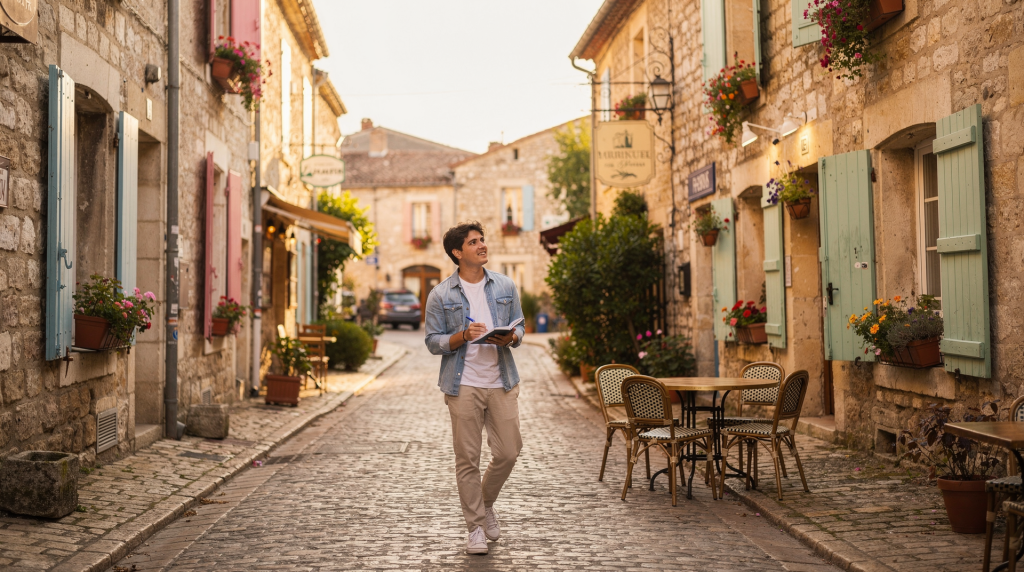
A French village is one of the best classrooms you can have. The language is short, practical, repetitive, and tied to real life: greetings, bread, directions, timing, small talk, and the social habits that make village life feel very French. If you want to learn French in a way that actually sticks, one day in a village can give you a full, usable mini-immersion.
Why a French village is such a good language classroom
Village life gives you the vocabulary people use every day, not the polished phrases from textbooks. You hear the same exchanges again and again in the bakery, at the market, in the café, on the street, and when asking for help or directions.
That repetition matters. Practical language methods consistently work better when French is part of a routine, not a special study session. A village makes that easy because the same situations happen every day: buying bread, greeting neighbours, checking opening hours, and chatting briefly with shopkeepers.
What makes it especially powerful is that the setting itself reinforces the words. When you walk into a boulangerie and smell the warm dough, the phrase « Je voudrais une baguette, s’il vous plaît » stops being an abstract exercise. It becomes a physical, sensory moment. In a village, the bakery is often also a tiny social hub where the boulangère knows everyone’s usual order. That rhythm of predictable, friendly exchange is a gift for a learner: you can rehearse your line, deliver it, and get a warm « Merci, bonne journée » in return. No classroom can replicate that.
The village rhythm: what you can learn at each moment
The day in a French village has a natural cadence, and each part of it offers a distinct set of language tools. Here is what you can expect to encounter and what to listen for.
| Moment in the day | Real-life French you need | What to listen for |
|---|---|---|
| Morning bakery run | Bonjour, s’il vous plaît, une baguette, une tradition, c’est combien ? | Polite formulas, numbers, basic food vocabulary |
| Market visit | Je voudrais, combien ça fait ?, c’est local ? | Quantity, price, origin, preference |
| Asking for directions | Excusez-moi, où est… ?, tout droit, à gauche, à côté de | Location words, landmarks, simple instructions |
| Café stop | Un café, un verre d’eau, l’addition, s’il vous plaît | Ordering, small talk, payment words |
| Village walk | On voit, on entend, il y a, c’est ancien, c’est près de… | Describing what you see around you |
| Evening recap | Aujourd’hui, j’ai acheté, j’ai vu, j’ai demandé | Past tense in very simple form |
Notice how each time slot is tied to a concrete action. That’s the secret: you’re not memorising lists, you’re living the language. The market, for instance, is a goldmine for numbers and weights. When a maraîcher tells you « deux euros le kilo » or « une barquette de fraises à trois euros cinquante », your brain links the sound to the object in your hand. In the Drôme, you might hear « c’est de la région » a lot, because local provenance is a point of pride. That simple phrase teaches you both vocabulary and a cultural value.
A practical one-day immersion plan
You don’t need a complex itinerary. A few well-chosen moments, approached with attention, will give you more usable French than a week of passive listening.
1. Start with a simple listening goal
Before leaving your room, decide what you want to notice: greetings, food words, directions, or numbers. Short, focused listening is more useful than trying to catch everything.
A useful beginner rule:
- Listen for one theme only
- Repeat one sentence aloud
- Write down three new words
- Use them once before lunch
This isn’t about being perfect. It’s about training your ear to pick out patterns. If you’re in a village in Provence, the accent might soften the ends of words; in Brittany, the rhythm can be more clipped. Your goal is simply to tune in to the local music of the language.
2. Begin at the bakery
The boulangerie is usually the easiest first stop because the exchange is short and predictable. Watch for these patterns:
- Bonjour / Bonsoir
- Je voudrais…
- S’il vous plaît
- C’est combien ?
- Merci, bonne journée
Useful phrase chunk:
Je voudrais une baguette, s’il vous plaît.
That one line teaches ordering, politeness, and pronunciation without forcing you to build a sentence from scratch. In many villages, the bakery is also where you’ll see the « tradition » baguette, made with a longer fermentation and no additives. Asking for « une tradition, s’il vous plaît » immediately marks you as someone who pays attention to local habits. And don’t underestimate the power of « Bonjour » before you say anything else — in a small community, entering a shop without greeting the person behind the counter is considered abrupt, even rude. The word itself is your entry ticket.
3. Use the market for real vocabulary
Markets are excellent for concrete words: fruit, vegetables, cheese, quantities, and prices. If you are not confident speaking, begin with questions that have simple answers:
- C’est local ?
- C’est de la région ?
- Vous me conseillez quoi ?
- C’est mûr ?
This is also where you can hear regional habits in action. In some places, people move quickly and keep exchanges very brief; in others, the stallholder will chat, explain the produce, and ask where you are from. Both are useful listening practice. In the Drôme, for example, you’ll often hear « c’est du pays » — it’s from the local area — and the names of small villages where the cheese or apricots come from. Those place names are part of the language too, and learning them helps you read a landscape as well as a menu.
4. Practice directions in context
Villages force you to use location language because streets, lanes, churches, squares, and parking areas are often compact and easy to walk to. Ask for directions even if you already know where you are going.
Try:
- Excusez-moi, où est la mairie ?
- C’est loin ?
- Je cherche la poste.
- Je vais au centre du village.
Key words to notice:
- à côté de
- en face de
- près de
- tout droit
- au bout de
These small words are powerful. They make up a large part of everyday French and they appear constantly in spoken directions. In a medieval village, you might also hear « la ruelle » (the narrow lane), « le lavoir » (the old wash house), or « la place de l’église ». These are not just directions; they are clues to how the village is organised and how people think about their space. When someone says « c’est juste après le porche », you’re learning both a preposition and a feature of stone-built architecture.
5. Sit in the café and listen like a learner
A café is not just a break; it is a listening lab. You can hear ordering language, routine greetings, and often a slower rhythm than in a busy city setting.
Focus on:
- ordering drinks
- asking for the bill
- hearing time expressions
- noticing how people greet each other
Try writing down one real phrase you hear, then use it later the same day. That helps convert passive listening into active use. In a village café, the « petit noir » (espresso) is a ritual, and the « addition » often comes with a hand gesture. You might hear « comme d’habitude » — the usual — which tells you that regulars have their established order. That’s a phrase worth borrowing: it signals belonging, even if you’re just visiting.
The best French to learn from village life
Not all vocabulary is equally useful. If your goal is practical fluency, prioritise language that appears every day.
High-value vocabulary clusters
- Greetings and farewells
- Food and shopping
- Numbers and prices
- Directions and places
- Time and opening hours
- Courtesy phrases
- Simple descriptions
- Small talk about weather, travel, and routine
Low-value vocabulary for this setting
- Rare academic terms
- Long verb tables without context
- Abstract vocabulary you cannot use immediately
- Fancy expressions that villagers are unlikely to say in ordinary conversation
The distinction is crucial. In a village, you’re far more likely to need « c’est ouvert le lundi ? » than a subjunctive conjugation. The language of daily life is built on these high-frequency clusters, and they are the ones that will let you participate, not just observe.
A simple observation method
If you want to learn quickly, do not try to translate everything. Instead, use a three-step process:
- Notice the phrase.
- Guess the meaning from context.
- Reuse it the same day.
Example:
- You hear: On ferme à midi.
- You infer: It closes at noon.
- You later say: À quelle heure vous fermez ?
That cycle is how village immersion becomes actual language progress. Short, repeated exposure works better than passive background listening alone. The beauty of this method is that it mirrors how we all learned our first language: by grabbing a useful chunk and trying it out immediately. In a village, the feedback is instant — a nod, a smile, a reply — and that reinforcement cements the phrase in your memory far more effectively than a flashcard ever could.
Common mistakes learners make
1. Trying to speak perfectly
In a village, clarity matters more than a perfect accent. Use short sentences and polite formulas. People usually respond well when the intention is clear.
2. Studying only before the outing
French becomes easier when it is attached to the experience itself. Label what you see, say what you want, and repeat the words after the interaction.
3. Chasing too many new words
Three useful words a day are enough if you actually use them. Too much vocabulary leads to confusion and weak recall.
4. Avoiding conversation
Short exchanges are not failures. They are the point. Buying bread or asking for directions is real speaking practice, not a warm-up.
5. Ignoring routine phrases
The same formula words appear everywhere. Bonjour, s’il vous plaît, merci, excusez-moi, je voudrais — these are the backbone of village French.
A village-language checklist
Use this before, during, and after your day.
- I know my one listening goal
- I can say bonjour, s’il vous plaît, merci, excusez-moi
- I can ask for a price
- I can ask where something is
- I can name at least five foods
- I can describe one thing I see
- I can repeat one phrase I heard
- I can write a short recap in French
A model day of village immersion
Morning
- Buy bread
- Say hello first
- Ask the price
- Repeat the seller’s goodbye phrase
Midday
- Visit the market
- Ask one question about origin or recommendation
- Notice numbers, weights, and descriptions
Afternoon
- Walk through the village
- Ask for directions, even if you do not need them
- Read signs, notices, and opening hours
Evening
- Sit at a café or write in a notebook
- Record five useful words
- Say or write three sentences about the day
Example recap:
Aujourd’hui, j’ai acheté du pain.
J’ai demandé où était la mairie.
J’ai entendu plusieurs fois “tout droit”.
How to turn one village day into a weekly habit
A single day is useful, but repetition creates fluency. Build a small routine:
- One bakery interaction
- One market question
- One direction question
- One written recap
- One short listening session
This kind of rhythm matches what works in daily French learning more broadly: frequent exposure, short practice blocks, and immediate reuse. If you live near a village or can visit one regularly, the routine becomes a natural part of your week. Even if you’re only passing through, the habit of extracting a few phrases from each visit adds up quickly. Over time, you’ll notice that the same words — tout droit, à côté de, c’est combien ? — appear in every interaction, and they start to feel like your own.
FAQ
Is a French village better than a city for learning French?
A village is often better for beginners because the exchanges are shorter, more repetitive, and easier to connect to daily life. A city gives you more variety, but a village gives you stronger routine vocabulary. In a village, you’re also more likely to encounter the same people, which builds familiarity and reduces the anxiety of speaking.
What level of French do I need?
Very little. You can start with greetings, numbers, food words, and a few question patterns. Even basic French is enough for useful immersion. The key is to use what you know without hesitation.
What if people switch to English?
Stay polite and keep the French simple. Short phrases usually invite more French than long explanations. If someone replies in English, you can still answer in French — most people will follow your lead once they see you’re making an effort.
How do I learn without feeling overwhelmed?
Focus on one situation at a time: bakery, market, directions, or café. Trying to learn everything in one day weakens retention. The village itself provides a natural structure; just follow its rhythm.
Should I write down every new word?
No. Write down only words you can imagine using again that same day or the next day. A notebook full of random vocabulary is less helpful than three words you actually say out loud.
Conclusion
A French village teaches language in the most practical way possible: through real errands, small rituals, and repeated human contact. If you listen carefully, ask simple questions, and reuse what you hear, one day in the village can give you more useful French than hours of abstract study. The goal is not perfection. It is to make French part of the rhythm of the day, le vrai quotidien.