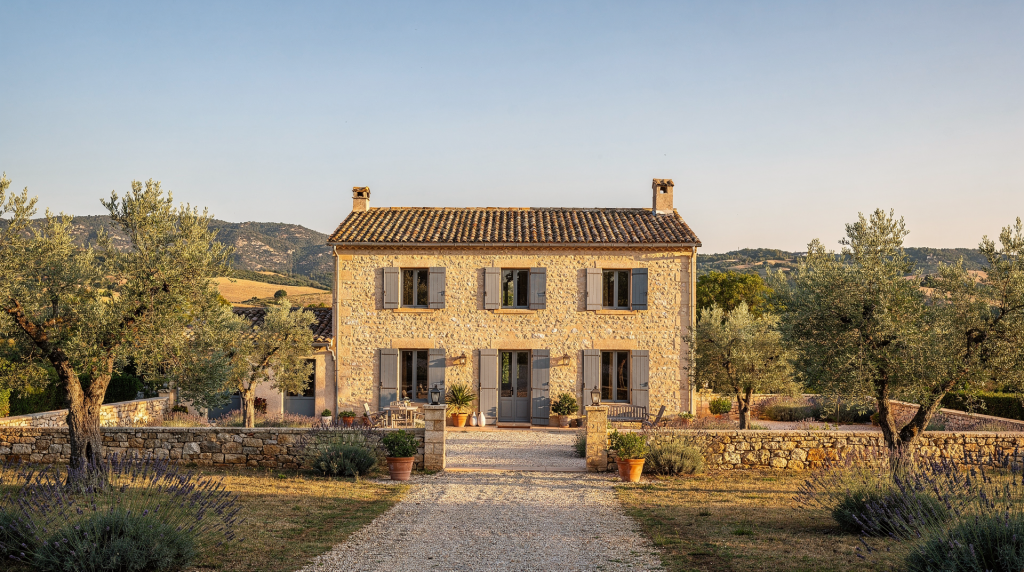
When you start looking at property in Provence, you quickly encounter two words that carry a lot of weight: mas and bastide. They appear in listings, in conversation with agents, and in the dreams of buyers who imagine stone walls, plane trees, and the sound of cicadas. But a Provençal farmhouse is far more than a postcard. It is a building shaped by centuries of agricultural life, local materials, and a climate that can be both generous and harsh. Understanding what you are really buying—structurally, legally, and financially—makes the difference between a wise purchase and an expensive lesson.
What Exactly Is a Provençal Farmhouse?
In practical terms, a Provençal farmhouse is a traditional rural stone house built for agricultural life in Provence. A mas is usually the more authentic farm building: low-built, functional, and shaped by the land rather than by symmetry. The word itself comes from the Latin mansus, a dwelling with land, and in local usage it still carries that rooted, working character. A bastide is often more formal and refined, with a more estate-like feel. In some parts of Provence you will also hear campagne used loosely for a country house, but mas and bastide remain the terms that matter most when you are buying.
Typical defining features
- Thick stone walls for thermal mass and insulation
- Small or restrained openings on the windward side
- South-facing orientation to capture light
- Low-pitched roof with tuiles canal or Roman tiles
- Exposed beams, terracotta floors, and lime render
- Outbuildings such as barns, cellars, sheds, or former stables
- Shaded courtyards, plane trees, or internal garden spaces
These homes were built to stay cool in summer, resist the mistral, and support farm work. That heritage explains both their charm and many of their buying risks. The thick walls, for instance, are wonderful in August but can stay cold and damp in winter if not properly maintained. The roof tiles, often handmade tuiles canal, are beautiful but require regular inspection: a single cracked tile can let water in and start a slow decay of the timber frame.
Mas vs Bastide: What’s the Difference?
The terms are often mixed up in listings, but the distinction still matters. An agent might call a property a bastide to suggest elegance, even when the building is fundamentally a farmhouse. As a buyer, you need to look past the label and read the building itself.
| Type | Main character | Typical feel | What buyers should expect |
|---|---|---|---|
| Mas | Rural working farmhouse | Rustic, grounded, often irregular in plan | Older structure, more renovation history, more agricultural context |
| Bastide | More formal country house | Elegant, symmetrical, estate-like | Often better presentation, sometimes more polished renovation, usually higher price |
In a listing, “bastide” can be used loosely to make a property sound more refined. Always look at the structure, not the label. A true mas might have a slightly haphazard layout because it grew organically over generations, with rooms added as the family or the farm expanded. A bastide, by contrast, was often built as a single architectural statement, with a central door and evenly spaced windows. Both can be wonderful, but they come with different expectations and often different price tags.
Architectural Features That Matter Most
A Provençal farmhouse is not only about stone walls and shutters. The real value lies in how the building performs and whether its original logic still works. When I walk through a property with students or friends who are thinking of buying, I always start with the same handful of points—they tell you more than any agent’s description.
1. Orientation
Traditional Provence houses are often oriented south or southeast to maximize sun and limit exposure to cold winds. The mistral, that fierce north wind, can make a poorly oriented house uncomfortable and expensive to heat. North-facing walls are usually more closed and protective, sometimes with only tiny openings. If the house has been renovated and someone added large north-facing windows, check how they perform in winter.
2. Wall thickness
Thick stone walls help regulate temperature naturally. This is part of the appeal, but it also affects insulation upgrades, moisture management, and heating response time. A stone wall can be 60 cm or more thick; it stores heat slowly and releases it slowly. That means a house can feel cool in the morning even in summer, and it takes time to warm up in autumn. If you add modern insulation on the inside, you risk trapping moisture in the stone—a classic renovation mistake. Lime render and breathable materials are your friends here.
3. Roof structure
Old tile roofs are beautiful, but they are also one of the most expensive elements to maintain. Check:
- roof age
- timber condition
- signs of movement or sagging
- tile replacement history
- insulation quality
A roof that looks charming from a distance may hide rotten beams or a patchwork of repairs. In Provence, the traditional tuiles canal are laid in a specific way: a lower row of curved tiles facing up, and an upper row facing down. If you see cement mortar smeared between them, that is a red flag—it traps water instead of letting it run off.
4. Openings and glazing
Small windows were originally meant to reduce heat and wind exposure. If the property has been modernized, check whether new windows respect the character of the house while improving comfort. Double-glazed units in a traditional frame can work well, but cheap PVC frames on a stone farmhouse are both an aesthetic and technical mismatch. Also, look at the lintels above windows: stone or wood lintels can crack over time, especially if larger openings were cut later.
5. Annexes and outbuildings
A former stable, barn, or cellar can add huge value—but only if planning permission, structural integrity, and access are all in order. A grange (barn) might look like an easy guest house conversion, but if it is not connected to water and electricity, or if the local plan local d’urbanisme (PLU) restricts change of use, it becomes a liability. Always ask for the certificat d’urbanisme to understand what is legally possible.
Why These Homes Are So Attractive
The appeal of a Provençal farmhouse is not just visual. Buyers are usually drawn to a very specific combination:
- authentic regional identity
- land and privacy
- outdoor living
- stone architecture with history
- a climate that suits terraces, courtyards, and gardens
- the possibility of a permanent home, holiday base, or hospitality project
For many buyers, the emotional appeal is strong. The trap is letting that outweigh practical due diligence. I have seen people fall in love with a micocoulier (hackberry tree) shading a courtyard and overlook the fact that the roof needed €40,000 of work. The tree is lovely, but it will not keep you dry.
Price Ranges: What to Expect in Provence
Prices vary enormously depending on location, land size, renovation standard, and whether the property is in a sought-after area such as the Luberon, Alpilles, or near the Riviera.
A stone farmhouse with land and a pool in the Luberon is commonly seen in the €700,000 to €1,500,000 range, depending on acreage and renovation level. In premium Provence listings, farmhouses often sit far above that level, with many properties advertised from roughly €1.5 million upward. In the Alpilles, proximity to Saint-Rémy-de-Provence or Maussane-les-Alpilles can push prices even higher. By contrast, in the less touristic parts of the Var or the northern Vaucluse, you might still find a mas in need of work for under €400,000—but you will trade proximity to famous villages for a quieter, more local rhythm of life.
Main factors that drive price
- proximity to a famous village or market town
- views, privacy, and land size
- whether the house is fully renovated
- swimming pool, guest house, or outbuildings
- quality of access road and parking
- whether the property is in a protected or heritage-sensitive zone
- rarity of comparable properties nearby
Price logic by condition
| Condition | Typical buyer profile | Budget impact |
|---|---|---|
| Move-in ready | Buyer wanting comfort and speed | Highest asking price, lower immediate renovation risk |
| Light updating needed | Buyer with some flexibility | Balanced price, moderate works budget |
| Full renovation project | Experienced buyer or investor | Lower purchase price, but renovation costs can be substantial |
When you see a mas listed at a surprisingly low price, the first question is always: what is the real cost of making it livable? A €300,000 farmhouse can easily swallow another €300,000 in structural work, drainage, and insulation before you even think about the kitchen.
Renovation Costs: The Hidden Variable
Old Provençal farmhouses can be deceptively expensive to restore. Recent market guidance notes that renovation on a 200 m² farmhouse can range roughly from €150,000 to €900,000, depending on the condition and ambition of the work. That is a wide range, and it reflects the difference between a cosmetic refresh and a full structural overhaul.
Common renovation expenses
- roof replacement or repair
- damp treatment
- electrical rewiring
- plumbing and drainage upgrades
- insulation that respects the old structure
- window and shutter restoration
- septic system or drainage compliance
- pool installation or legal regularization
- structural reinforcement
A cheap purchase price can become a costly total project if the building needs major work. I always advise buyers to get at least two detailed devis (quotes) from local artisans before committing. Local builders understand the materials and the regulations, and their estimates often reveal hidden costs that a general survey might miss.
Buying Considerations: What to Check Before You Offer
This is where many buyers lose money. A Provençal farmhouse should be treated as both a home and a technical property. The charm of a stone façade does not excuse you from checking the drainage, the roof timbers, and the legal status of every outbuilding.
Essential checks
- building structure and cracks
- roof condition and timber frame
- damp, rising moisture, and salt damage
- insulation and heating performance
- water supply and drainage
- septic tank compliance
- boundaries and land title
- access rights and easements
- previous permits for extensions, pools, or outbuildings
- local planning rules and heritage restrictions
Listings often highlight the beauty but hide the practical details. Reliable property pages and agencies increasingly emphasize diagnostics, drainage, and planning details because they are decisive before purchase. In France, the seller must provide a dossier de diagnostic technique (DDT) that includes energy performance, lead, asbestos, termites, and natural risk zones. Read it carefully—it is not just a formality.
Planning Rules and Heritage Restrictions
In Provence, land use can be tightly controlled, especially near historic villages, protected landscapes, or heritage zones. Before buying, verify:
- the local urban plan (plan local d’urbanisme or PLU)
- whether the property sits in an ABF-controlled area (Architecte des Bâtiments de France)
- whether the land is constructible
- if previous work was properly authorized
This matters if you want to add a pool, convert an outbuilding, or extend the house. Inherit the wrong building history, and you may inherit expensive compliance problems too. The ABF can refuse a new window or dictate the exact shade of shutters. I have seen buyers discover, too late, that their charming pigeonnier (dovecote) cannot legally become a guest room because it sits in a protected sightline.
How to Read a Listing Like a Professional
A well-written listing is useful, but it rarely tells the whole story. French property ads have their own coded language. Look for the following signals:
Positive signs
- clear mention of recent roof work (toiture refaite)
- documented renovation history
- energy and drainage diagnostics provided
- good orientation and natural light
- legal outbuildings
- realistic floor area and land description
Warning signs
- vague phrasing like “renovation needed” (à rafraîchir or travaux à prévoir)
- no mention of septic system (assainissement)
- no structural details
- too many euphemisms about “authenticity” (beaucoup de charme often means “a lot of work”)
- photos taken only at ideal summer light
- unexplained annexes or extensions
Pay attention to what is not said. If the listing mentions a vue dégagée (open view) but shows no photo of the view, ask why. If it says rare à la vente (rare on the market), that can be true—or it can mean the property has been sitting unsold for a reason.
Step-by-Step Buying Approach
1. Define the use
Ask yourself whether this is:
- a primary residence
- a second home
- a rental or hospitality project
- a full-time renovation project
That choice changes the budget and the level of risk you can accept. A holiday home you visit only in July and August might forgive a damp corner that would be unbearable in November.
2. Set a total budget
Include:
- purchase price
- notaire fees (typically 7-8% for older properties)
- survey and diagnostics
- renovation reserve
- furnishings
- annual maintenance
3. Inspect in person
Never judge a farmhouse from photos alone. Visit in different light if possible. Summer visits can hide dampness, cold rooms, and drainage problems. If you can, come back on a windy day to feel how the mistral hits the house, or after heavy rain to see where water pools.
4. Order specialist advice
Bring in:
- a building surveyor (expert en bâtiment)
- a roofer or structural specialist
- a French-speaking local advisor if needed
- a notaire for legal points
5. Verify legality
Confirm that all visible modifications were declared and approved. An unpermitted pool or a converted barn without déclaration préalable can become your problem after purchase.
Checklist for Buyers
- Check roof age and condition
- Inspect for damp and cracks
- Ask for all diagnostics
- Confirm sewage and drainage compliance
- Review planning permissions
- Verify outbuildings and extensions
- Estimate heating and insulation costs
- Check road access and parking
- Confirm land boundaries
- Budget for hidden works
Typical Mistakes Buyers Make
- Falling in love with the setting. A beautiful olive grove does not fix a failing roof.
- Underestimating renovation. Stone does not mean low maintenance. In many cases, it means the opposite.
- Ignoring local rules. A pool or extension that looks harmless can become a legal problem.
- Buying too quickly in peak season. Summer light flatters everything. Moisture, wind exposure, and insulation issues often appear later.
- Assuming “character” means “quality”. Some charming properties are structurally excellent. Others are visually appealing but technically weak.
I would add a sixth mistake: not learning the local vocabulary. When a seller says cuisine d’été (summer kitchen), it might be a lovely outdoor cooking space—or a crumbling lean-to with a rusty sink. Knowing the words helps you ask the right questions.
Who a Provençal Farmhouse Is Best For
A Provençal farmhouse suits buyers who want:
- a distinctive regional property
- outdoor space and privacy
- a renovation project with character
- a home that reflects local building traditions
- long-term ownership rather than a quick resale
It is less suitable for buyers who want:
- low maintenance
- urban convenience
- energy-efficient new-build simplicity
- predictable renovation costs
Final Takeaway
A Provençal farmhouse can be an exceptional purchase, but only if the beauty, price, and practical reality all line up. The smartest buyers look beyond the stone façade and judge the house like a building, a legal asset, and a long-term maintenance commitment. When you understand how a mas was built to work with the land, the wind, and the sun, you start to see it not just as a dream, but as a home you can actually live in—through every season.
FAQ
What is the difference between a mas and a bastide?
A mas is usually the older rural farmhouse type, more functional and agricultural in origin, while a bastide is generally more formal and estate-like. In practice, the terms overlap in listings, but a mas tends to have a more irregular, evolved layout, and a bastide often shows deliberate architectural symmetry.
Are Provençal farmhouses expensive?
Yes, especially in the most desirable areas. Prices often start around the high hundreds of thousands and can move well into the millions depending on land, location, and condition. In the Luberon or Alpilles, a renovated farmhouse with land and a pool rarely appears below €700,000, and top properties easily exceed €1.5 million. Less famous corners of Provence offer more accessible entry points, but they still require a serious budget.
Is renovation always necessary?
Not always, but many older farmhouses need at least some technical work. Roofs, drainage, insulation, and damp control are common priorities. Even a house that looks well maintained may have hidden issues like outdated wiring or a non-compliant septic system. A thorough inspection is essential.
What should I inspect first?
Start with the roof, walls, dampness, drainage, and legal status of any extensions or outbuildings. These elements determine the fundamental safety and legality of the property, and they are the most expensive to fix if neglected.
Can I add a pool or extension?
Sometimes, but only after checking planning rules, heritage restrictions, and local zoning. In protected zones, even a modest pool can require approval from the Architecte des Bâtiments de France. Always verify the plan local d’urbanisme and any existing permits before making an offer.