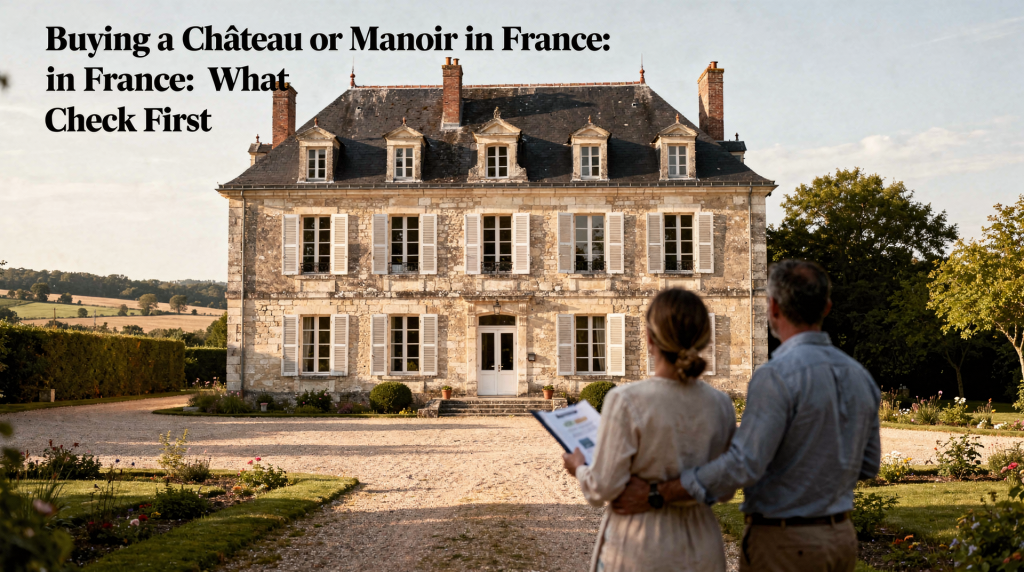
Buying a château or manoir in France is less about finding a romantic ruin and more about understanding what you are actually taking on. The smartest first step is to check the building’s legal status, structural condition, planning constraints, and true running costs before you fall in love with the view.
A historic property can be a beautiful home, a project, or a financial trap depending on what is hidden behind the façade. For that reason, the first checks should focus on the parts that are hardest and most expensive to fix: roof, structure, damp, services, title, heritage rules, and access to permits.
Why château and manoir purchases need a different approach
A château or manoir is not just a larger version of a country house. These properties often come with thicker walls, older materials, more complex ownership history, and extra planning or heritage restrictions. A standard residential mindset is not enough.
The key difference is this: in a historic property, the visible charm is rarely the expensive part. The costly issues are usually structural, regulatory, or hidden in the maintenance history. I’ve walked through dozens of these buildings in regions from the Périgord to the Drôme, and the ones that looked the most enchanting from the lane were often the ones with the longest list of urgent, unglamorous repairs. A manoir’s elegant pierre de taille façade can conceal a roof that’s been quietly failing for a decade, while a château’s turret might be a masterpiece of 17th-century craftsmanship—and a magnet for damp if the lead flashings were last replaced before the Revolution.
The first question: what are you really buying?
Before any emotional decision, clarify the category of the property. French listings love to use the word château loosely, but legally and practically, the distinction matters. A manoir is typically a fortified or semi-fortified manor house, often with agricultural origins, while a château can range from a modest 18th-century country seat to a sprawling Loire Valley estate. The tax implications, the renovation permissions, and even the insurance premiums shift depending on how the property is classified.
Check whether the property is:
- a primary residence
- a second home
- a renovation project
- a heritage property with protected status
- a property with land, outbuildings, or agricultural elements
- a house with event, hospitality, or commercial potential
This matters because each category changes the risks, the financing, and the permissions you may need later. For instance, if you plan to run chambre d’hôtes or host weddings, the local mairie will want to see compliance with public safety norms that a private residence never has to meet.
Ask the seller or agent for:
- exact parcel references
- title details
- floor plans, if available
- boundaries and land size
- list of outbuildings
- recent works and permits
- utility and heating information
- whether the property is protected or near a protected zone
If the answer is vague, that is already a warning sign. In my experience, a seller who cannot produce a clear cadastre map or hesitates to share the diagnostics is often hoping you won’t ask too many questions.
Start with title, rights, and legal status
One of the first checks is whether the seller has clean title and the right to sell the property without complications. You also need to know whether there are mortgages, servitudes, rights of way, or other charges attached to the property. French property law is deeply rooted in the Napoleonic code, and even a seemingly straightforward sale can hide a servitude de passage that allows the neighbour to drive their tractor through your courtyard every morning.
Legal points to verify
- ownership title
- servitudes and easements
- rights of way
- unpaid debts or charges
- local pre-emption rights
- zoning and planning status
- heritage protection status
If the property is close to a monument or is itself protected, future changes may need extra approval. This can affect everything from windows and roofing materials to extensions, terraces, and pool placement. I’ve seen buyers purchase a lovely 16th-century gentilhommière only to discover the Architecte des Bâtiments de France (ABF) would not allow them to replace the rotting wooden shutters with anything but identical, hand-carved replicas—at a cost that rivalled the purchase price of a small apartment.
Important French terms to know
- notaire: the legal professional who handles the transaction. Unlike in some countries, the notaire is a public official who acts for the state as much as for the parties, ensuring the deed is legally watertight.
- compromis de vente: the preliminary sales agreement. This is the moment when the buyer and seller commit, but it usually includes a 10-day cooling-off period for the buyer.
- acte de vente: the final deed of sale, signed at the notaire’s office, often months after the compromis.
- servitude: a legal right affecting use of the land—think of it as an easement that can be positive (right to pass) or negative (restriction on building).
- PLU (Plan Local d’Urbanisme): the local planning rules that dictate what you can build, how tall, and with which materials.
- ABF (Architecte des Bâtiments de France): the heritage authority that may control changes in protected zones, from the colour of your render to the shape of your dormer windows.
The mandatory diagnostics are not enough on their own
In France, the seller must provide a diagnostic file, the Dossier de Diagnostic Technique (DDT). This can include asbestos, lead, termites, electricity, gas, energy performance, sanitation, and risk reports. It’s a legal requirement, and it gives you a snapshot of certain risks—but it was designed for standard housing stock, not for a 400-year-old manor with walls a metre thick and a roof structure that has seen five centuries of storms.
That file is useful, but for a château or manoir it is only the starting point.
What the diagnostics help you identify
- asbestos risks
- lead paint
- termite presence
- gas and electrical safety issues
- energy performance
- sanitation compliance
- flood, industrial, or natural risks
What they do not fully tell you
- real structural stability
- quality of past repairs
- hidden water ingress
- roof life expectancy
- the cost of bringing the property up to your standard
- whether the building suits your intended use
A property can have “acceptable” diagnostics and still require a major budget for real work. I remember a manoir in the Lot where the DDT looked almost reassuring, yet a closer look revealed that the entire south gable was slowly separating from the main building because of a failed lintel over a blocked-up window—a detail no standard report would flag.
The first practical inspection: roof, structure, damp, and services
If only four things are checked first, these should be the four. In a historic building, they are the skeleton, the skin, the lungs, and the nervous system. Get them wrong, and everything else becomes a cosmetic exercise on a failing body.
1. Roof
A roof is one of the most expensive elements to repair on a historic building. Look for:
- missing or slipped tiles/slates
- sagging lines
- old ridge work
- blocked gutters
- water stains in the attic
- daylight where there should be none
A roof can look picturesque from the road and still be near the end of its life. In Provence, a roof of old tuiles canal may charm you with its undulating rhythm, but if the underlying volige (wooden boarding) is rotten, you’re looking at a full strip and relay. In the north, a slate roof might be original 19th-century ardoise from Angers—beautiful, but if the nails have rusted through, the slates will start sliding off in the next big wind.
2. Structure
Check for:
- cracks in load-bearing walls
- uneven floors
- movement in openings
- rotten or damaged beams
- signs of previous structural patches
Not every crack is serious, but every crack deserves an explanation. A vertical fissure following a joint in a stone wall might be nothing more than thermal movement, while a diagonal crack widening towards the top of a wall often signals foundation settlement. I’ve learned to ask the local maçon (stone mason) rather than rely on my own eyes: they can read the stone like a book.
3. Damp and water management
Historic buildings often breathe differently from modern ones, but damp still matters. Old walls were designed to absorb and release moisture; sealing them with modern cement renders or impermeable paints traps water and accelerates decay. Look for:
- salt marks on walls
- mould smells
- flaking plaster
- wet cellar walls
- poor drainage around the property
- water running toward the house instead of away from it
In many regions, the vide sanitaire (crawl space) or cellar was the building’s original damp management system. If it’s been filled in or poorly ventilated, damp will climb. A drain français (French drain) around the perimeter is often the first sensible investment, but it must be done with respect for the building’s original hydrology.
4. Services
Old properties often hide outdated systems. Check:
- electrical installation
- heating system
- plumbing
- water pressure
- septic tank or sanitation setup
- internet and mobile reception if you need regular connectivity
In a château, the electrical panel might be a museum piece of ceramic fuses and fabric-wrapped wiring. Heating could be a single oil-fired boiler trying to warm thirty rooms through cast-iron radiators that haven’t been bled since de Gaulle was president. And don’t assume fibre internet reaches the countryside: I’ve taught French lessons over a 4G hotspot in a stone house where the walls killed the signal dead.
Use a specialist surveyor or builder before you get emotionally attached
For a château or manoir, a local builder, structural surveyor, or restoration specialist can save you from the most expensive mistakes. A standard viewing is not enough if you plan to renovate or if the property is clearly older and complex. In France, the concept of a “building survey” as known in the UK is less common, but you can hire an expert en bâtiment or a bureau d’études structure to give you a detailed report.
Ask for a reality-based opinion on:
- roof replacement timing
- structure and beam condition
- damp treatment
- likely compliance upgrades
- annual maintenance burden
- renovation phasing
- approximate cost bands, not fantasy numbers
A useful expert is not the one who admires the property. It is the one who tells you what will be expensive. I once walked through a manoir with a couvreur (roofer) who barely glanced at the turret and instead spent ten minutes staring at a gutter joint. “That,” he said, “will cost you €15,000 if you don’t fix it this year.” He was right.
Check planning and heritage restrictions early
This is one of the most important first checks in France. Many historic properties are subject to planning controls that can limit what you can alter. The French system distinguishes between monuments historiques classés (fully protected) and inscrits (partially protected), but even if your château isn’t listed, it might sit in a site patrimonial remarquable or within the périmètre de protection of a nearby church. That means the ABF has a say.
Investigate:
- the PLU or local planning rules
- whether the property is in a heritage zone
- whether the ABF has oversight
- whether the property is listed or protected
- whether nearby land is restricted
- whether extensions, pools, or annexes are allowed
If the property is in a protected area, even small changes may require formal approval. That includes windows, façades, roofs, shutters, and sometimes colours and materials. I’ve seen the ABF refuse permission for double-glazed windows because the profile was 2mm too thick, insisting on hand-made wooden frames that matched the originals exactly.
Typical mistake
Buyers assume they can “modernise later.” In protected areas, “later” may mean “only with permissions,” and sometimes “not in the way you imagined.”
Check land, access, and boundaries
A château often comes with land, gardens, woods, or fields. That sounds ideal until you discover practical problems. The cadastre map is your friend, but it’s not always perfectly up to date. Boundaries can be marked by ancient oak trees, streams, or stone walls that have shifted over centuries.
Verify:
- exact boundaries
- access roads
- shared driveways
- public rights of way
- maintenance responsibility for gates, walls, and tracks
- land use classification
- any agricultural or rural land issues
If the property has extensive land, ask who maintains roads, ditches, hedges, and drainage. A beautiful avenue of plane trees can become a recurring cost when you realise you’re responsible for pruning them every three years to keep the Département happy.
Understand the real running cost before buying
Many buyers focus on purchase price and renovation cost, then underestimate the ongoing burden. Historic properties usually cost more to maintain every year. The rule of thumb among local artisans is that you should budget around 1–2% of the property’s value annually for maintenance, but for a château with extensive outbuildings, that figure can easily double.
Budget for:
- roof and gutter upkeep
- heating fuel or system upgrades
- damp control
- garden and grounds maintenance
- insurance
- tree work
- septic or sanitation maintenance
- emergency repairs
A simple rule: if the house is old, isolated, and large, annual maintenance is not optional. It is part of the property. In the Drôme, I budget for a ramonage (chimney sweep) twice a year, gutter clearing after the autumn leaves, and a yearly check of the toiture by a local roofer who knows the particular weaknesses of tuiles écaille.
Finances: can you really carry the project?
Mortgages for château purchases can be harder to secure, especially for unusual or heavily renovated properties. Even if financing is available, lenders may be cautious. French banks will often ask for a detailed devis (quote) for the renovation works and may only release funds in stages as work progresses.
Before making an offer, calculate:
- purchase price
- notaire fees
- immediate repair costs
- contingency budget
- furnishing and heating costs
- professional fees
- taxes and insurance
- holding costs during renovation
A serious buyer should think in stages:
- acquisition cost
- emergency works
- habitability works
- comfort works
- long-term improvement
That sequence keeps the project realistic. I’ve seen too many people spend their entire budget on a new kitchen while the roof still leaks into the attic.
A simple first-check checklist
Before you go further, confirm:
- title is clear
- boundaries are defined
- no hidden legal charges are obvious
- diagnostics have been provided
- roof condition is understood
- structure has been inspected
- damp is assessed
- utilities are checked
- planning constraints are reviewed
- heritage restrictions are identified
- access and land use make sense
- budget includes contingency
Common mistakes buyers make
1. Falling in love before doing the boring checks
Romance is useful for motivation, but terrible for budgeting. The coup de cœur is a French real estate tradition, but it should never replace a cold, hard look at the diagnostics and the roof timbers.
2. Assuming old walls mean “it just needs cosmetic work”
In historic buildings, cosmetic work is often the smallest line item. I’ve seen a salon with exquisite 18th-century boiseries that needed nothing more than a gentle wax, while the floor joists beneath it were being eaten by capricornes (wood-boring beetles).
3. Ignoring the planning framework
A property may be buyable but not easily alterable. The PLU and the ABF are not optional; they are the guardians of the French built landscape, and they take their role seriously.
4. Trusting one viewing trip
A château can show beautifully in spring sunlight and reveal major issues after the first rain. Visit in different weather, and if possible, bring your specialist with you on the second visit.
5. Underestimating the maintenance burden
Large grounds and old materials need regular care, not occasional attention. A parc of several hectares with century-old trees requires a bûcheron (tree surgeon) on speed dial, not just a ride-on mower.
Step-by-step: what to do first
- Gather all legal and property documents.
- Confirm title, boundaries, and any charges or servitudes.
- Review the mandatory diagnostics.
- Inspect the roof, structure, damp, and services.
- Check local planning rules and heritage status.
- Confirm access, land use, and outbuildings.
- Estimate annual running costs.
- Get a specialist opinion before making a serious offer.
- Build a realistic renovation budget with contingency.
- Only then decide whether the property fits your plans.
Quick comparison: what matters most at the first stage
| Area | Why it matters | What to look for first |
|---|---|---|
| Title and legal status | Prevents ownership surprises | Servitudes, charges, ownership, pre-emption rights |
| Roof | Major cost risk | Leaks, age, sagging, attic stains |
| Structure | Safety and long-term value | Cracks, movement, damaged beams |
| Damp | Hidden damage and repair bills | Mould, salts, drainage issues |
| Planning and heritage | Controls future changes | PLU, ABF, protected status |
| Services | Habitability and compliance | Electricity, heating, sanitation, water |
| Land and access | Day-to-day practicality | Boundaries, roads, rights of way |
FAQ
Do I need a special survey for a château or manoir?
Yes. A historic property deserves a specialist structural opinion, not just a casual viewing. Look for an expert en bâtiment ancien or a local architecte du patrimoine who understands traditional construction.
Are the mandatory diagnostics enough?
No. They are important, but they do not replace a broader building assessment. Think of the DDT as a legal minimum, not a condition report.
Can I renovate freely after buying?
Not always. Planning rules and heritage restrictions may limit what you can change. Even interior works can require a déclaration préalable if the building is listed.
What is the biggest early mistake?
Buying without checking the roof, structure, damp, and planning constraints. Everything else can be phased, but these four determine whether the project is viable at all.
Is a château always expensive to maintain?
Usually yes, but the real issue is not just expense. It is unpredictability. The more complex the building, the more important it is to inspect properly before committing. A small manoir in good condition can be surprisingly manageable, while a grand château with a leaking roof can drain your reserves in a single winter.
Conclusion
Buying a château or manoir in France can be deeply rewarding, but only if the first checks are done with discipline. Start with the legal framework, then inspect the roof, structure, damp, and services, and always verify planning and heritage restrictions before you imagine any renovation.
The best historic purchases are not the ones that look the most romantic at first glance. They are the ones where the buyer understood the risks early, budgeted honestly, and bought with clear eyes. In the end, a château is not just a home—it’s a commitment to a piece of French history, and that commitment deserves a clear-headed beginning.