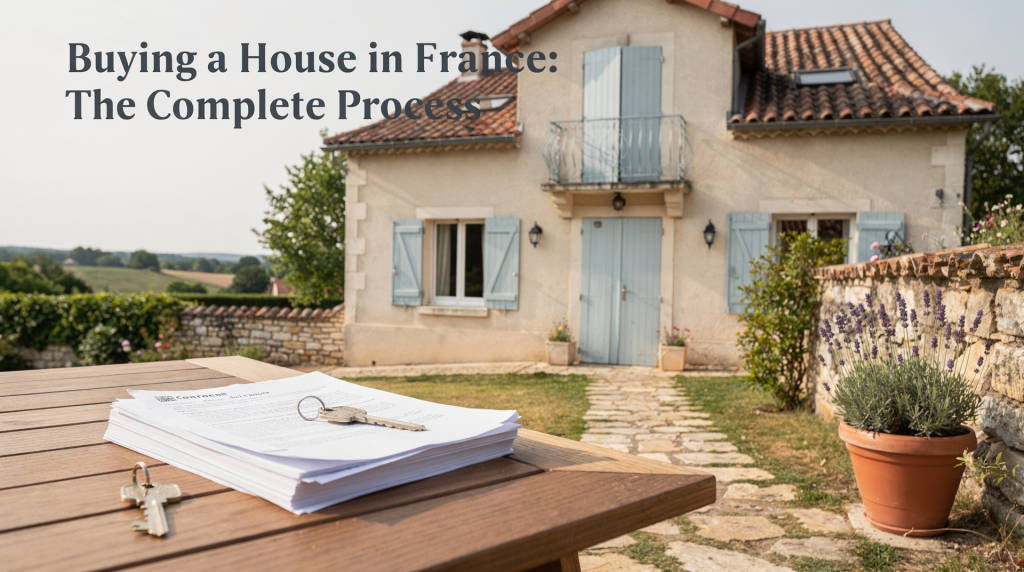
Buying a house in France is straightforward once you understand the rhythm: offer, preliminary contract, cooling-off period, legal checks, final deed, keys. The process is highly structured, and the notaire sits at the centre of it, making sure the sale is legally clean and properly recorded.
What makes the French buying process different?
In France, a property purchase is not just a private deal between buyer and seller. It becomes a formal legal transaction early on, usually at the stage of the compromis de vente or promesse de vente, and the notaire oversees the legal side of the transfer. This is not a bureaucratic quirk—it is a deliberate system designed to protect both parties and guarantee the state’s interest in land registration.
A few features often surprise foreign buyers:
- The first binding contract comes earlier than in many countries. Once you sign, you are in a legally serious phase, not a provisional one.
- Buyers usually get a mandatory 10-day cooling-off period after signing. This is a statutory right you cannot sign away, and it applies only to the buyer.
- The final signing, the acte de vente, happens at the notaire’s office, where ownership is transferred and the keys are handed over. It is a formal, almost ceremonial moment.
- The seller must provide a technical diagnostics file, the Dossier de Diagnostics Techniques, covering items such as energy performance, lead, asbestos, gas, electricity, termites, and flood-related risks. This is not a mere formality; it can fundamentally alter your budget.
The complete process, step by step
1) Define your budget properly
The purchase price is only part of the real cost. I have seen too many buyers fixate on the headline figure and then discover they need an extra €30,000 just to make the house habitable. In France, older homes often come with character and hidden costs in equal measure.
You should budget for:
- Purchase price
- Notaire and transfer fees (often called frais de notaire, though most of it is tax)
- Mortgage costs, if applicable
- Survey, diagnostics review, and legal advice
- Immediate repairs or works
- Furniture, utilities, and insurance
A useful rule: if the property is more than 50 years old, set aside at least 10–15% of the purchase price for urgent work. Even a charming stone house can hide plumbing, roofing, or insulation work that the diagnostics will only hint at.
2) Search for the right property and inspect it carefully
Once you start viewing houses, think like a buyer and an inspector. French estate agents often use coded language: à rafraîchir (needs refreshing) usually means a full redecoration, while gros œuvre bon (good shell) suggests everything else is tired. Learn to read between the lines.
Check:
- Roof condition
- Damp and ventilation
- Window quality
- Heating system
- Electrical panel
- Septic tank, if relevant
- Water pressure and drainage
- Access, parking, and seasonal road issues
- Orientation and natural light
- Noise from roads, bars, or neighbours
In rural France, a beautiful house can still be impractical if access is poor in winter or renovations are more extensive than expected. In villages, also pay attention to local rules, shared walls (murs mitoyens), and any protected heritage constraints. I once viewed a farmhouse in the Drôme that looked idyllic in August but turned out to be unreachable for a week after heavy snow because the track was privately maintained and not cleared.
3) Make an offer
An offer is usually made verbally or in writing. Once accepted, the process moves quickly into the legal phase. At this stage, clarify:
- Whether the price includes fixtures and fittings (meubles meublants or just the bare walls)
- Who pays agency fees
- Whether any conditions need to be added
- Target dates for signature and completion
A good offer is not only about price. It should reflect the property’s condition, the market, and your financing situation. In a slow market, you might negotiate; in a sought-after village, a clean offer without a mortgage condition can be more attractive to the seller.
4) Sign the preliminary contract
The first major contract is usually the compromis de vente; sometimes you may see promesse de vente instead. Both are legally binding in different ways, but the practical effect is similar: you are now committed, subject to any conditions.
This contract sets out:
- Buyer and seller details
- Full property description
- Agreed purchase price
- Deposit amount
- Timeline to completion
- Conditions suspensives, or conditions that must be met before completion
The deposit is commonly 5–10% of the purchase price and is held in escrow, usually by the notaire. This money is not touched until completion or a valid withdrawal.
Compromis de vente vs promesse de vente
| Term | What it means | Practical point |
|---|---|---|
| Compromis de vente | A mutual commitment to buy and sell at an agreed price; both parties are bound. | The standard contract for most transactions. Once signed, neither side can easily back out. |
| Promesse de vente | A unilateral promise from the seller to sell to the buyer under certain conditions, often for a limited time. | Gives the buyer an option; more common when the buyer needs time to arrange finance or when the seller wants to keep some flexibility. |
| Acte de vente | Final deed transferring legal ownership. | Signed at the notaire’s office; keys are handed over and the property becomes yours. |
For most buyers, the key point is simple: once you sign the preliminary contract, you are moving into a legally serious phase, so do not treat it like a casual reservation.
5) Use the cooling-off period wisely
After signing, the buyer has a mandatory 10-day cooling-off period during which they can withdraw without penalty and recover the deposit. This délai de rétractation is a powerful protection, and it starts the day after you receive the signed contract by registered mail.
Use this time to:
- Read every clause carefully
- Verify financing
- Review diagnostics
- Confirm boundaries and cadastral information
- Check planning rules for extensions or renovations
- Reconfirm moving dates and practical logistics
This is one of the most valuable protections in the French process. Do not waste it. I have known buyers who used the cooling-off period to get a second opinion on a suspiciously low energy rating and ended up renegotiating the price.
6) Make sure the conditions suspensives are right
Conditions suspensives are safety clauses that allow the sale to collapse if a specific condition is not met. They are your contractual escape hatches, and they must be drafted clearly.
Typical examples:
- Mortgage approval
- Planning permission for a project
- Absence of serious title issues
- Sale of your current home, if the deal is structured that way
For buyers needing finance, the mortgage clause is crucial. If the loan is refused and the clause is properly written, you are usually protected. The clause should specify the loan amount, interest rate ceiling, and deadline. A vague clause is almost useless.
7) The notaire carries out the legal checks
The notaire verifies the legal status of the property and the sale. This is not a rubber-stamp exercise; the notaire is personally liable for the accuracy of the title transfer.
They will typically check:
- Ownership title and its history over the past 30 years
- Easements and rights of way (servitudes)
- Planning and cadastral records
- Mortgages or charges attached to the property
- Required seller documents
- Local legal and tax issues
This is why the notaire is more than a signature witness. They are the legal safety net of the transaction, and their fee is regulated by the state.
8) Arrange finance and prepare the funds
If you need a mortgage, the timing matters. The loan process should be aligned with the completion date in the contract. French banks can be slow, so start early.
Before completion, make sure you have:
- Mortgage approval
- Evidence of funds
- Bank transfer timing confirmed
- Any currency exchange plan in place, if buying from abroad
Late transfer problems can delay completion, so banks and currency providers should be handled early, not at the last minute. I have seen completions postponed by a week because an international transfer took longer than expected.
9) Review the diagnostics and the final paperwork
The seller must provide technical diagnostics, and these should be checked seriously rather than skimmed. The Dossier de Diagnostics Techniques is often a thick folder, and its contents can reshape your budget.
Typical issues revealed include:
- Poor energy rating (anything below D can mean high bills and future renovation obligations)
- Old electrics
- Presence of asbestos or lead
- Termite risk
- Gas installation concerns
- Flood exposure
These reports do not just formality. They affect renovation cost, insurance, compliance, and sometimes whether you should renegotiate or walk away. Pay particular attention to the energy performance certificate (diagnostic de performance énergétique): from 2025, the worst-rated homes (G) cannot be rented out, which can affect resale value.
10) Sign the final deed: acte de vente
The acte de vente is the final deed of sale. It is signed at the notaire’s office, with both parties or their representatives present. The atmosphere is often surprisingly calm: the notaire reads aloud key clauses, you sign, and then the keys are handed over.
At this appointment:
- The remaining balance is paid
- Fees and taxes are settled
- Ownership transfers
- Keys are handed over
That is the moment the house becomes legally yours. You will later receive a copy of the titre de propriété, your official proof of ownership.
How long does it take?
A typical French purchase often takes around two to three months from preliminary contract to completion, though it can be longer if finance, paperwork, or legal issues slow things down. Rural properties with complex boundaries or missing documents can stretch to four or five months.
Delays often come from:
- Mortgage approval
- Missing seller documents
- Boundary or title complications
- Rural property issues
- International bank transfers
- Works needing extra permissions
Costs to expect beyond the purchase price
Buying a house in France involves more than the price on the listing. The frais de notaire alone can add 7–8% of the price for older properties, though for new builds it is lower. These fees are mostly taxes and disbursements, not the notaire’s pocket.
Common extra costs include:
- Notaire fees and taxes
- Mortgage arrangement fees
- Property survey or specialist inspection
- Building works
- Insurance
- Moving costs
- Utility setup
- Local taxes after purchase (taxe foncière and taxe d’habitation, though the latter is being phased out for main residences)
A useful rule: if the property is older, keep a separate reserve for repairs. Even a charming stone house can hide plumbing, roofing, or insulation work.
Practical checklist before you sign
- Confirm your total budget, including fees and repairs
- Read the diagnostics carefully
- Verify that the cadastral layout matches the actual land
- Ask about rights of way, shared walls, and access
- Check whether any works need planning permission
- Make sure your mortgage clause is strong enough
- Understand the deposit terms
- Confirm the completion timeline
- Ask who pays agency fees
- Get translation or legal help if the contract language is unclear
Common mistakes foreign buyers make
- Treating the first contract as informal
- Underestimating renovation costs
- Ignoring diagnostics because the house “looks fine”
- Assuming land boundaries are obvious
- Forgetting that rural access can be seasonal or shared
- Not checking whether outbuildings are legally declared
- Waiting too long to organise finance
- Signing without understanding the conditions suspensives
Special considerations for older or rural houses
France has a huge stock of older homes, and that is part of the charm. It is also where practical issues multiply. A 200-year-old farmhouse in the Ardèche or a village house in the Luberon comes with thick stone walls, uneven floors, and a history written in its beams—but also with potential damp, outdated wiring, and septic tanks that no longer meet modern standards.
Pay extra attention to:
- Stone walls and humidity
- Roof age and insulation
- Septic systems
- Shared wells or water rights
- Easements over tracks or driveways
- Heritage restrictions
- Renovation permissions in protected areas
If you are buying for long-term living, ask a very simple question: can this house work for daily life in winter, not just in August?
FAQ
Is the notaire my lawyer or the seller’s lawyer?
The notaire is a public official who handles the legal transfer and ensures the sale is valid. They act impartially, though in practice the buyer often chooses the notaire. You can also have your own notaire alongside the seller’s, at no extra cost since the fee is split.
Can I withdraw after signing?
Yes, during the mandatory 10-day cooling-off period for the buyer, you can withdraw without penalty. After that, you are bound unless a condition suspensive fails.
How much deposit do I need?
Usually 5–10% of the purchase price, held in escrow. The exact amount is negotiable but rarely below 5%.
Do I need to be in France for completion?
Not always. A representative can sometimes sign on your behalf with a power of attorney, depending on the setup. This is common for foreign buyers, but the proxy must be arranged in advance and accepted by the notaire.
What is the most important document to read carefully?
The preliminary contract, especially the conditions suspensives and the diagnostics file. Every clause matters, and a mistranslation can be costly.
Final thought
Buying a house in France is less about speed than about sequence. If you respect the order—offer, preliminary contract, cooling-off, checks, finance, final deed—you dramatically reduce risk and make the process much calmer.
In France, a good purchase is not just about finding a beautiful house. It is about understanding the legal rhythm, the paperwork, and the real condition of the property before you say oui.