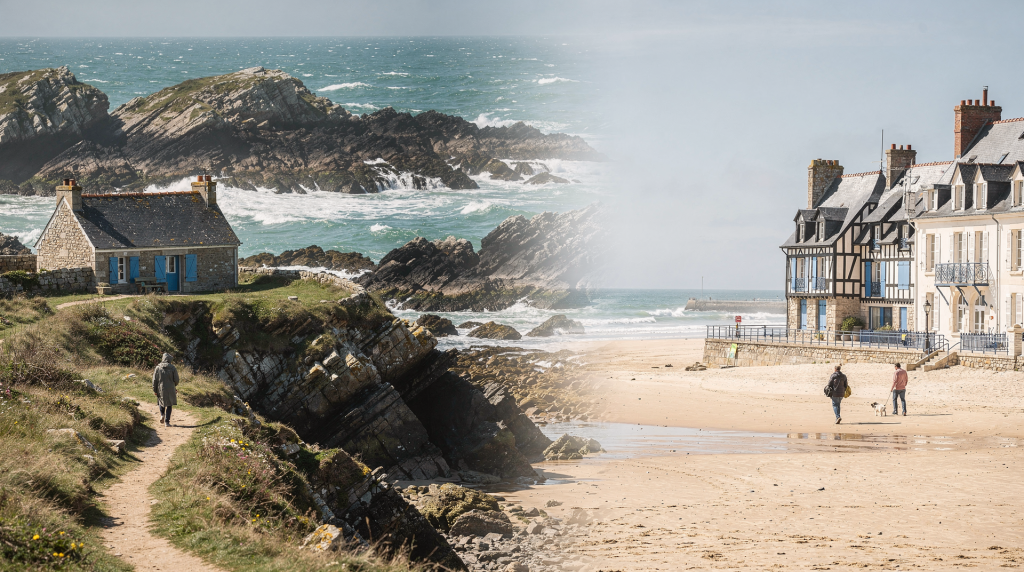
When you’re weighing up Brittany against Normandy, the choice goes far deeper than postcard views. It’s about the rhythm your days will settle into, the way the weather seeps into your habits, and how strongly a region’s identity colours everything from market chatter to the shape of a roof. Both are coastal, both are steeped in history, both are unmistakably French — but they don’t live the same life. Having helped countless learners and newcomers decode the cultural undercurrents of French regions, I’ve seen how these two neighbours can feel like different countries once you start paying attention to the details.
At a glance: the practical difference
Before diving into the nuances, a side-by-side snapshot helps ground the comparison. The table below captures the broad strokes — climate, landscape, identity, food, and the everyday mood — but remember that within each region, microclimates and local pockets can shift the experience considerably.
| Topic | Brittany | Normandy |
|---|---|---|
| Climate | Oceanic, changeable, often windier; southern Brittany is milder and brighter than the north | Oceanic too, but often a little calmer and slightly warmer in summer inland |
| Landscape | Rugged coastlines, granite, moorland, dramatic light | Pastoral countryside, beaches, river valleys, softer scenery |
| Identity | Strong Celtic identity, Breton language and symbols still visible in public life | Strong regional pride, but generally more integrated into a wider French cultural frame |
| Food culture | Galettes, crêpes, oysters, cider, butter, seafood | Apples, cider, cream, cheese, seafood, especially dairy-rich cooking |
| Everyday mood | More maritime, raw, sometimes wild; people often describe it as fiercely local | More pastoral, historic, and “settled,” with a gentler pace in many towns |
Climate: similar on paper, very different in lived experience
Both regions sit under a maritime sky, which means mild winters, cool summers, and rain that’s spread across the year rather than dumped in a single season. But that textbook label hides the textures that actually shape your daily life — how often you’ll reach for a windbreaker, whether your terrace faces the right microclimate, and how much the light changes from hour to hour.
Brittany climate in real life
Brittany wears its Atlantic temperament on its sleeve. The weather here doesn’t just change; it performs. A morning of sharp, crystalline light can dissolve into low, fast-moving cloud by lunch, and the wind is a constant companion — sometimes a whisper, often a roar. Coastal stretches, especially the exposed northern and western headlands, bear the full brunt of this, while southern Brittany, particularly around the Golfe du Morbihan, enjoys a noticeably milder and sunnier disposition. The local microclimates are so pronounced that you’ll hear Bretons talk about the “Cornouaille effect” or the sheltered pockets around the Rance estuary as if they were different countries.
For everyday living, this means:
- Outdoor plans need built-in flexibility — a picnic might become a brisk walk, and that’s part of the charm.
- Housing demands solid insulation and wind-proofing; traditional granite walls and thick slate roofs weren’t just an aesthetic choice, they were a survival strategy.
- Garden, terrace, and beach life depend less on the regional forecast and more on your immediate microclimate — a south-facing courtyard in Vannes feels worlds apart from a clifftop garden in Finistère.
Normandy climate in real life
Normandy shares the same maritime DNA, but its expression is often softer, more settled. Inland areas, especially the rolling hills of the Pays d’Auge or the Orne valley, can feel almost continental in summer — warmer, stiller, with a gentler breeze. That doesn’t mean you can pack away the umbrella; rain remains a possibility in any month, but the overall sensation is less raw, less wind-whipped than Brittany’s ocean-facing edges. The coast, of course, has its own drama — the Cotentin peninsula and the cliffs of Étretat can be every bit as blustery — but step a few kilometres inland and the climate often relaxes.
For practical planning:
- Normandy can feel easier if you’re after a temperate climate that doesn’t dominate your day.
- Inland areas suit those who want slightly warmer summers without sacrificing proximity to the sea.
- Coastal zones, particularly exposed headlands, still carry a strong maritime punch — don’t underestimate the wind if you’re house-hunting near the Baie de Seine.
Quick climate takeaway
- Choose Brittany if you like weather with personality: wind, sea spray, dramatic light, and a stronger sense of the ocean in daily life.
- Choose Normandy if you prefer a gentler balance: still coastal, still changeable, but often a touch less raw.
Lifestyle: what daily life feels like
The lifestyle difference isn’t about busy versus quiet — both regions know how to slow down — but about the atmosphere that seeps into your bones. It’s the difference between a morning market where the vendor greets you in Breton-accented French and one where the conversation drifts towards the best local Camembert.
Brittany lifestyle
Brittany often feels more self-contained, more ruggedly itself. Coastal towns like Concarneau or Douarnenez still hum with the rhythm of the fishing port, while inland villages of grey granite seem to grow out of the moorland. There’s a pride here that isn’t loud but is unmistakable — you see it in the ubiquitous Gwenn ha Du flags, in the fest-noz dances that fill village halls, and in the way locals will gently correct your pronunciation of a place name that looks unpronounceable to outsiders. Life outside the summer crush is slow, grounded, and deeply connected to the sea. Even the architecture tells the story: thick stone cottages (often called penty in Breton-influenced areas) were built to hunker down against the elements, and their modest, sturdy forms reflect a culture that values resilience over show.
Common lifestyle traits include:
- A strong connection to the sea and outdoor life — sailing, coastal hiking, and tide-watching are part of the weekly rhythm.
- A slower, more grounded pace outside the tourist season, when many coastal villages return to a quiet, almost private existence.
- Visible regional pride in symbols, festivals, and local products — from the triskel to the artisanal cider served in a bolée.
Normandy lifestyle
Normandy feels more pastoral, more layered with agricultural history. Here, the landscape is a patchwork of orchards, dairy farms, and half-timbered villages that seem arranged for a painter’s eye. Towns like Bayeux or Honfleur carry their history gracefully, but the daily pace often feels more domestic, more settled. The connection to the land is strong — you’re as likely to overhear a conversation about the apple harvest as about the tides. Architecturally, the region’s longères (long, low farmhouses) and colombages (half-timbered façades) speak of a culture rooted in farming and craftsmanship, where the house was designed to work with the landscape rather than defy it.
Common lifestyle traits include:
- Strong food traditions tied to dairy, apples, and cider — a visit to a local market often becomes a lesson in the AOC boundaries of Pont-l’Évêque or Livarot.
- A calmer feel in many inland areas, where the rhythm follows the seasons rather than the tourist calendar.
- A lifestyle that suits people who want countryside without losing access to coast and culture — you can be in the middle of the bocage and still reach the beach in half an hour.
If Brittany can feel like the sea is always present, Normandy can feel like the land and the coast are in a quieter conversation.
Local identity: why these regions do not feel interchangeable
This is where the difference becomes deepest, and where language itself becomes a window into how people see their place in the world. The way a region names its streets, its dishes, its houses tells you a lot about who it thinks it is.
Brittany: Celtic memory still matters
Brittany’s identity is not a museum piece; it’s a living, breathing thing. The Celtic heritage is visible in dual-language road signs (where Kemper sits alongside Quimper), in the Breton-language schools known as Diwan, and in the fact that you’ll hear Kenavo as often as Au revoir in some pockets. Even where Breton isn’t spoken daily, it remains culturally alive through music, storytelling, and a fierce local pride that can surprise newcomers. Place names are a map of this identity: the prefixes plou- (parish), tre- (hamlet), and ker- (village) are everywhere, and learning to decode them is like learning the region’s secret language.
You feel this identity in:
- Medieval towns like Dinan or Vannes, where references to Breton history and Arthurian legend are woven into the stonework.
- Public cultural events — from the Festival Interceltique in Lorient to the smallest village pardon (religious procession) — that reinforce a sense of belonging.
- A sense that the region is proudly itself, not just “another part of France” — and that this selfhood is non-negotiable.
Normandy: proud, historic, but less separatist in feel
Normandy’s identity is no less real, but it tends to express itself differently. Here, pride is often channelled through historical memory — the Bayeux Tapestry, the D-Day beaches, the legacy of William the Conqueror — and through a deep attachment to the land and its produce. The Norman language (a langue d’oïl dialect) survives in pockets and in the names of dishes like teurgoule or bourdelot, but it rarely has the same public visibility as Breton. Instead, Norman identity feels more integrated into the broader French story: a strong regional accent rather than a separate cultural lane. When you read a property listing here, you’ll encounter terms like chaumière (thatched cottage) or clos (walled orchard), which speak to a landscape shaped by centuries of farming and gentle domestication.
You feel this identity in:
- Commemorations of local history and heroes — from the Viking roots to the Liberation — that are woven into the calendar.
- Distinct food traditions and orchard culture that define the rhythm of autumn and the character of the countryside.
- Towns and villages that feel anchored in everyday French life, where the local pride is warm but rarely asserts itself as a separate nationhood.
Identity in plain English
- Brittany: stronger regional distinctiveness, more visible cultural markers, more “this is its own world.”
- Normandy: strong pride, but usually more integrated into the broader French cultural landscape.
Food culture: two coastal regions, two different tables
Food is one of the easiest ways to feel the difference — and one of the most reliable shortcuts to understanding a region’s soul. The ingredients, the techniques, the names of dishes all carry the imprint of climate, history, and identity.
Brittany on the table
Brittany’s cuisine is built on the trinity of buckwheat, butter, and the sea. The galette de sarrasin (buckwheat crêpe) is not a tourist cliché; it’s a staple that sustained generations of farmers and fishermen, and it remains the everyday lunch of choice in many towns. The butter here — often salted, always proud — is a direct reflection of a dairy tradition shaped by coastal pastures. Oysters from Cancale or the Rade de Brest, spider crabs, and cotriade (a fisherman’s stew) speak to a maritime culture that treats seafood as a birthright. Even the cider, typically drier and more rustic than its Norman cousin, tells a story of orchards that have learned to thrive in wind-swept conditions.
Normandy on the table
Normandy’s table leans into richness and roundness. Apples are the backbone — not just in cider and Calvados, but in dishes like poulet vallée d’Auge (chicken with cream and apples) and the countless tarts that appear in autumn. Cream and butter are used with a generosity that can startle the uninitiated, and the cheese board — Camembert, Pont-l’Évêque, Livarot, Neufchâtel — is a map of the region’s dairy heartlands. The cuisine feels fuller, more anchored in the soil than the sea, though the coast still contributes excellent scallops, sole, and mussels. The vocabulary of the Norman kitchen — teurgoule (rice pudding), fallue (brioche), bourdelot (apple pastry) — is a gentle reminder that this is a culture that has long known how to transform simple ingredients into comfort.
Food comparison checklist
- If you want crêpes, galettes, oysters, and salty sea air, Brittany is the stronger match.
- If you want cream, apples, cheese, and cider, Normandy is likely to feel more natural.
Housing and built environment: the regions also look different
For anyone thinking beyond a holiday, the built environment is where climate, culture, and daily life literally take shape. The houses aren’t just scenery; they’re a direct response to the land and weather, and they’ll dictate your maintenance budget, your comfort, and your sense of belonging.
Brittany housing feel
Brittany is granite country. The stone here is hard, grey, and often left exposed, giving villages a timeless, almost austere beauty. Roofs are typically of dark slate, steeply pitched to shed rain and wind. Traditional cottages — often called penty or simply maison en pierre — are low-slung, with small windows that once kept out the Atlantic gales. When you read a Breton property listing, you’ll encounter terms like pierre apparente (exposed stone), ardoise (slate), and longère (though more common in Normandy, the term appears here too for elongated farmhouses). The architecture speaks of a region that has always had to stand up to the elements, and that practicality has become its aesthetic signature.
Normandy housing feel
Normandy’s built environment is softer, more varied. Half-timbered houses (maisons à colombages) are the postcard image, their timber frames filled with brick or plaster, often painted in warm ochres and creams. Thatched roofs (chaumières) appear in the countryside, especially in the Pays d’Auge, and the long, low farmhouses known as longères are a staple of rural listings. Brick and flint also make appearances, particularly in the east. The overall feel is more sheltered, more domestic — houses that seem to nestle into the landscape rather than brace against it. For a buyer, this often means a wider choice of styles, but also a need to understand the specific maintenance quirks of timber and thatch.
Why this matters for buyers and long-term residents
If you’re house-hunting, the climate and identity aren’t abstract. They affect:
- Roof and wall maintenance — slate vs. thatch, granite vs. timber frame each come with their own rhythms and costs.
- Exposure to wind and moisture — a granite cottage on a Breton headland will demand different upkeep than a sheltered longère in the Norman bocage.
- Whether you want sea-facing living or more sheltered countryside — and how that choice shapes your daily view and your heating bills.
- How much “regional character” matters in your daily environment — living in a building that feels unmistakably Breton or Norman can deepen your sense of place, but it also ties you to a specific architectural language.
Which region suits which kind of person?
| If you want… | Better fit |
|---|---|
| A stronger local identity and visible regional culture | Brittany |
| Slightly gentler inland summers and a calmer feel | Normandy |
| Wild coastlines, dramatic weather, and maritime energy | Brittany |
| Pastoral landscapes, orchard country, and a softer pace | Normandy |
| Buckwheat galettes, Celtic heritage, and sea-driven life | Brittany |
| Apples, cream, cheese, and historic countryside | Normandy |
How to choose in practice
Before deciding, ask yourself these questions — ideally while standing in a local market or sitting in a café in each region, listening to the cadence of the language around you:
- Do I want weather that feels expressive and changeable, or more moderate and settled?
- Do I want my region to have a strong, visible local identity — one that shows up in street signs and everyday greetings?
- Would I rather live closer to a dramatic coast or a softer inland landscape?
- Do I prefer a food culture built around seafood and buckwheat, or dairy and orchards?
- Am I looking for a place that feels distinct from the rest of France, or comfortably part of it?
If you’re moving long term, spend time in each region outside peak summer. That’s when you’ll see the real pace of life, the weather habits, and the local tone — and when you’ll learn whether the sound of the wind or the smell of apple orchards feels like home.
Common mistakes people make
- Assuming “west of France” means the same experience everywhere — the cultural and climatic shift between Brittany and Normandy is real and often underestimated.
- Choosing only on beach photos and ignoring wind, rain, and winter light — a sunny August afternoon in Dinard tells you nothing about a drizzly February morning in Saint-Malo.
- Overlooking how regional identity affects daily life, not just festivals — it influences everything from neighbourly interactions to the availability of certain foods.
- Forgetting that microclimates matter, especially in Brittany — a house just a few kilometres inland can feel like a different climate zone.
- Treating coastal living as purely scenic, when it also changes housing, maintenance, and transport choices — salt air is lovely, but it’s also corrosive.
A simple decision rule
- Pick Brittany if you want a stronger sense of place, more dramatic Atlantic weather, and a clearly distinctive regional identity.
- Pick Normandy if you want a gentler coastal rhythm, pastoral beauty, and a region that feels historic without being as culturally marked.
FAQ
Is Brittany colder than Normandy?
Not always in a simple way, but Brittany is often windier and more exposed, while Normandy can feel slightly milder inland in summer. The wind chill in Brittany can make a moderate temperature feel much cooler, so don’t judge by the thermometer alone.
Which region has the stronger local identity?
Brittany is usually considered the more distinct region culturally, thanks to its Celtic heritage and visible Breton identity — you’ll see it in the flags, hear it in the music, and read it on the road signs.
Is Normandy better for peaceful countryside living?
For many people, yes. Normandy often feels more pastoral and settled, especially away from the main coastal hotspots. The bocage landscape creates a sense of intimacy and seclusion that’s harder to find in Brittany’s more open, windswept interior.
Is Brittany always rainy?
No. Brittany is changeable rather than permanently rainy. The key feature is the fast-moving oceanic weather, not constant rain. You’ll often experience several types of weather in a single day, which is part of its charm — and why locals always carry a K-way.
Which region is better for food lovers?
Both are excellent, but in different ways: Brittany for seafood, galettes, and cider; Normandy for apples, cream, cheese, and orchard-based cooking. Your preference might simply come down to whether you’d rather end a meal with a salted butter caramel or a Calvados-soaked apple tart.
Final thought
Brittany and Normandy are neighbours, but they offer two different ways of living with the coast. Brittany feels more elemental, more visibly distinct, and more tied to Celtic memory — a place where the sea is a constant, shaping presence. Normandy feels gentler, more pastoral, and more quietly French in tone — a landscape where history and agriculture have softened the edges. If you understand that difference, choosing between them becomes much easier. And once you’ve chosen, learning the local vocabulary — whether it’s the name of a traditional house type or the right way to order a crêpe — will be your first real step toward belonging.